Foot-Pounds to Newton-Meters: A Practical Guide
Learn how to convert foot-pounds to newton-meters and back with clear math, practical examples, and a ready-to-use calculator. Ideal for DIYers and technicians working with torque specifications.


What are foot-pounds and Newton-meters?
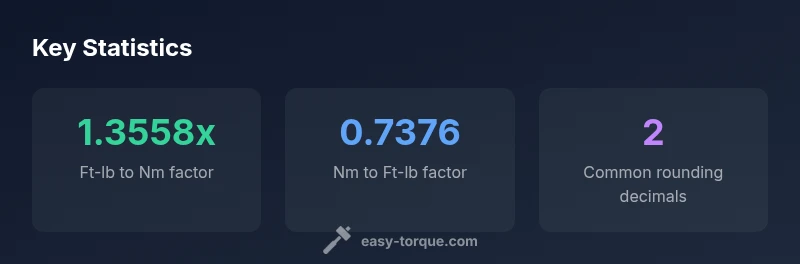
Torque is the rotational force you apply with a wrench. In the automotive and DIY worlds, two common units show up: foot-pounds (ft-lb) and newton-meters (Nm). The idea behind the phrase foot pounds a nm is that people often need to translate a value from one unit system to the other. In practical terms, knowing the relationship between ft-lb and Nm helps you interpret torque specs from manuals, service bulletins, and torque wrenches. For a quick mental check, remember that 1 ft-lb is roughly 1.356 Nm, and conversely 1 Nm is about 0.738 ft-lb. This relationship makes it easier to confirm that a given torque setting aligns with the manufacturer’s specification.
How the conversion works: the math behind the numbers
Conversions between ft-lb and Nm rely on a fixed conversion factor. The exact factors used in most manuals are:
- 1 ft-lb = 1.35581795 Nm
- 1 Nm = 0.737562149 ft-lb
To convert ft-lb to Nm, multiply by 1.35581795. To convert Nm to ft-lb, multiply by 0.737562149 (or divide by 1.35581795). In many workflows, you’ll round results to a practical precision (for example, 2–3 decimal places) to match the tolerance of the torque specification.
Step-by-step examples: common torque values
Let’s walk through a few concrete conversions:
- Example 1: 20 ft-lb to Nm → 20 × 1.35581795 = 27.116359 Nm ~ 27.12 Nm
- Example 2: 50 ft-lb to Nm → 50 × 1.35581795 = 67.7908975 Nm ~ 67.79 Nm
- Example 3: 90 Nm to ft-lb → 90 × 0.737562149 = 66.380593 ft-lb ~ 66.38 ft-lb
These examples illustrate how a torque value might appear on a repair manual, a torque wrench, or a parts spec sheet. Always verify with the exact conversion factor your tool uses, as manufacturers may round differently for practical purposes.
Precision and rounding: how many decimals do you need?
Rounding is guided by tolerance: some automotive specs tolerate only a small percentage deviation, while others specify exact values. A common practice is to round to two decimal places for everyday maintenance and to three decimals for critical assemblies. The calculator in this guide supports rounding to any number of decimals (0–6) to fit your workflow. When in doubt, check the service manual’s stated tolerance and adjust your rounding accordingly with consistent rules across all fasteners in a project.
Using the calculator in a real workflow
In real-world use, you’ll often see torque values presented in one unit and applied in another. Start by identifying the unit in the spec (ft-lb or Nm). Use the calculator to convert to the other unit, then compare to the wrench’s setting. For example, if a bolt spec is 30 ft-lb, convert to Nm to set a metric wrench or confirm with an Nm-specified torque wrench. Always ensure you’re using the same rounding convention used in the spec to avoid slight over- or under-tightening. This is where Easy Torque’s guidance and tools help you stay aligned with manufacturer intent and best practices.
Common mistakes to avoid and safety considerations
- Mixing unit systems without conversion can lead to incorrect torque and potential damage.
- Rounding too aggressively can push you outside the tolerance band.
- Assuming a Nm value directly matches a ft-lb setting without conversion. Always convert and verify.
- Temperature, lubricant type, and thread condition can affect effective torque; adjust for these factors as needed.
By adhering to consistent units and proper rounding, you reduce the risk of under- or over-tightening fasteners and improve reliability in assemblies.
Quick-reference conversions you should memorize
- 1 ft-lb ≈ 1.3558 Nm
- 1 Nm ≈ 0.7376 ft-lb
- 1 in-lb ≈ 0.1130 Nm (useful for very small fasteners)
Keeping these core facts in mind speeds up on-the-fly checks and supports safer, more accurate maintenance work.