How to Calculate Torque When Using a Crow's Foot
Learn how to calculate the correct torque when using a crow's foot on a torque wrench. Step-by-step formulas, measurement tips, and safety guidance for accurate tightening.


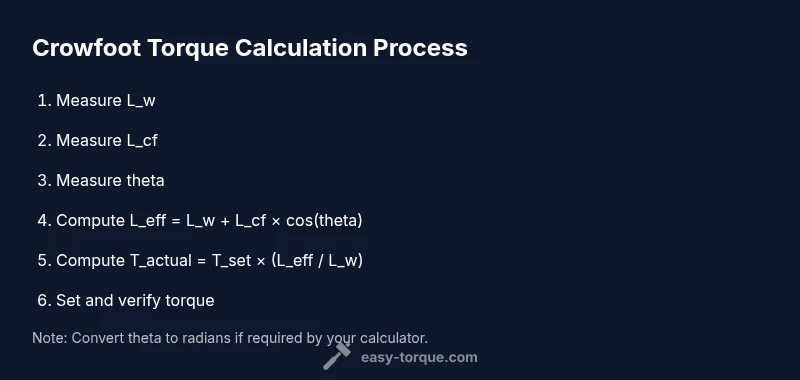
To accurately torque with a crow's foot, determine the wrench length L_w, crowfoot length L_cf, and angle theta, then compute L_eff = L_w + L_cf cos(theta) and T_actual = T_set × (L_eff / L_w). This lets you hit the true load on the fastener. According to Easy Torque, measure carefully and re-check with a test torque on a spare fastener.
Understanding Crowfoot Torque Extensions
Crowfoot extensions alter the lever arm of a torque wrench. When you attach a crowfoot, the distance from the fastener to where the force is applied changes, which can increase or, in some cases, leave unchanged the torque you actually apply. The orientation of the crowfoot relative to the wrench matters a lot: a crowfoot in line with the handle increases the effective lever arm, while a perpendicular setup can reduce this effect. For DIY mechanics and professionals, recognizing this geometry is essential to avoid under-tightening or over-tightening critical fasteners.
According to Easy Torque, beginning with a clear measurement plan reduces errors. You’ll need to quantify three key variables: the wrench length L_w, the crowfoot length L_cf, and the angle theta between the crowfoot and the wrench handle. With those, you can compute the effective lever length and the corrected torque reading.
The Core Formula: T_actual and T_set
The central idea is simple: torque at the fastener depends on the effective lever arm. The basic relationship is:
- L_eff = L_w + L_cf × cos(theta)
- T_actual = T_set × (L_eff / L_w)
Where:
- L_w is the wrench length from the handle center to the drive square.
- L_cf is the crowfoot length from the drive square to the fastener.
- theta is the angle between crowfoot and handle axis.
If you know your target fastener torque T_target, you can solve for the wrench setting:
- T_wrench = T_target × L_w / L_eff
These equations let you translate the wrench’s reading into the actual bolt load. In practice, small errors in measuring L_w, L_cf, or theta can shift T_actual by several percent, so precision matters.
From an engineering perspective, always verify the calculation with a test torque on a spare fastener or the recommended test piece. Easy Torque emphasizes verifying results on non-critical hardware before applying them to mission-critical joints.
Measuring L_w, L_cf, and Theta
Accurate measurements are the backbone of reliable torque corrections. Start by measuring L_w with a ruler or calipers from the wrench’s handle center to the drive square. Next, measure L_cf along the crowfoot’s centerline from the drive square to the fastener contact point. Finally, determine theta by visually aligning the crowfoot with the bolt axis or using a digital angle finder. If your crowfoot sits at an angle, record theta in degrees and convert to radians only if your calculator requires it.
Tip: Take multiple measurements and average them to reduce measurement error. If the crowfoot is not perfectly straight, measure the longest practical projection along the line of force for a conservative estimate.
Worked Examples: Inline Crowfoot and Perpendicular Crowfoot
Example A (inline, theta = 0°): L_w = 18 in, L_cf = 3 in, T_set = 50 ft-lb. L_eff = 18 + 3 × cos(0) = 21 in. T_actual = 50 × (21/18) ≈ 58.3 ft-lb. To hit exactly 50 ft-lb, set T_wrench = 50 × (18/21) ≈ 42.9 ft-lb.
Example B (perpendicular, theta = 90°): L_w = 18 in, L_cf = 3 in, theta = 90°. L_eff = 18 + 3 × cos(90) = 18 in. T_actual = 50 × (18/18) = 50 ft-lb. When theta is 90°, the reading is effectively the same as the wrench setting, so the crowfoot has minimal impact on the torque target.
These examples illustrate how angle and length interact. In real work, small geometry changes and friction at the fastener can introduce additional variance, so err on the side of verification.
Practical Tips for Real-World Use
- Always measure L_w, L_cf, and theta carefully; even small errors change T_actual noticeably.
- Prefer inline crowfoot configurations for predictable corrections; avoid unconventional angles when precision matters.
- If possible, calibrate your setup on a test fastener and compare the torque reading to the target torque.
- Record your measurement values and the resulting torque so you can repeat or adjust in future jobs.
- When in doubt, consult the torque wrench manufacturer’s guidelines for crowfoot usage to prevent tool damage or inaccurate readings.
Safety, Verification, and Common Mistakes
Accuracy here directly affects joint integrity. Never rely on instinct or a single measurement when a crowfoot is involved. Always verify with a test torque on a sacrificial or dummy fastener before applying to critical assemblies. Common mistakes include mismeasuring L_w or L_cf, misaligning theta, and neglecting cos(theta) in the calculation. Also, avoid forcing a wrench beyond its rated capacity by using an excessively long crowfoot combination, which can bend the wrench or produce unpredictable readings.
Tools & Materials
- Torque wrench with adjustable dial or digital readout(Ensure the range covers the target torque)
- Crow's foot extension (length known)(Measure from drive square to fastener contact)
- Measuring tools (caliper or ruler)(For L_w and L_cf lengths)
- Angle gauge or protractor(For theta measurement)
- Calculator or smartphone app(To compute L_eff and torque values)
- Notebook or digital note app(Record measurements and results)
Steps
Estimated time: 20-35 minutes
- 1
Gather tool and target values
Identify your torque wrench, crowfoot, and the fastener torque target. If you have an existing T_set, you’ll use it in the calculation; otherwise plan to compute T_wrench from your target. This step sets the goal for the calculation.
Tip: Having a written target torque helps prevent guesswork later. - 2
Measure L_w, L_cf, and theta
Measure L_w from the wrench handle center to the drive square, L_cf from the drive square to the fastener contact point, and theta as the angle between crowfoot and handle. Take multiple measurements and average for accuracy.
Tip: Record all three values with units for clarity. - 3
Compute L_eff and T_actual
Calculate L_eff = L_w + L_cf × cos(theta). Then compute T_actual = T_set × (L_eff / L_w). If you’re targeting T_target, solve for T_wrench = T_target × L_w / L_eff.
Tip: Use consistent units (inches or millimeters) throughout. - 4
Set the wrench and verify
Set the wrench to T_wrench (if you have a target) or validate T_actual via a test torque on a spare fastener. Check that the bolt or fastener holds with the expected load.
Tip: Proceed slowly and re-check after tightening the first fastener. - 5
Document and adjust
Document the measured L_w, L_cf, theta, and the resulting torque. If necessary, adjust your setup and repeat on the next fastener to maintain consistency.
Tip: Consistency builds reliability over time.
Your Questions Answered
What is a crow's foot torque adapter?
A crow's foot is a perpendicular extension attached to a torque wrench drive that lengthens the lever arm, altering the torque delivered at the fastener. It requires correction to achieve the desired torque.
A crowfoot is an attachment that changes the lever length of a torque wrench, so you must adjust your setting to reach the intended bolt torque.
Why does a crowfoot change torque readings?
Because the effective distance from the handle to the fastener changes with the crowfoot, changing the moment arm. The torque reading no longer matches the actual bolt torque unless corrected.
The crowfoot changes the lever arm, so the reading on the wrench can differ from the actual torque you apply unless you correct it.
How do I calculate corrected torque with a crowfoot?
Measure L_w, L_cf, and theta, compute L_eff = L_w + L_cf cos theta, then T_actual = T_set × (L_eff / L_w). To hit a target torque, set T_wrench = T_target × L_w / L_eff.
Measure the lengths and angle, compute the corrected length, and adjust the wrench setting to reach your target torque.
Is it safe to use a crowfoot with a torque wrench?
Yes, when used within the tool’s rated range and with proper corrections. Always verify with a test torque and follow manufacturer guidelines.
It's safe if you stay within the tool's range and verify the torque with a test.
Can I use this method on all torque wrenches?
This method applies to most wrenches with adjustable torque readings, but some special models may have different calibration behavior. Check the user manual for guidance.
Most wrenches support this, but check the manual for any device-specific notes.
What if theta is unknown?
Try to estimate theta by aligning the crowfoot as close to inline as possible and record your estimate. Recheck with a test torque to confirm the result.
If you don’t know the angle, estimate carefully and verify with a test torque.
Watch Video
Top Takeaways
- Calculate L_eff using L_w, L_cf, and theta to correct torque.
- Use T_actual = T_set × (L_eff / L_w) to determine true bolt load.
- Verify with a test torque on a safe surrogate fastener.
- Document measurements for repeatable results.