In-Lb to Nm: Master Torque Conversions
Learn how to convert inch-pounds to newton-meters (in-lb to Nm) with an exact formula, practical examples, and a simple calculator. Perfect for automotive DIY, torque wrenches, and safe fastener work.


Why the In-Lb to Nm Conversion Matters
Torque specifications guide how tightly fasteners should be tightened, and they are often provided in different units depending on the tool or the regional standard. For DIY mechanics, technicians, and hobbyists, understanding how to convert between in-lb (inch-pounds) and Nm (newton-meters) helps ensure you apply the correct torque regardless of the unit printed on a spec sheet or tool. Using the proper conversion minimizes the risk of damage to parts, threaded inserts, or gaskets and supports repeatable results across different jobs. In-lb to Nm conversions are especially important when you are using legacy tools that report torque in inch-pounds while the specification is in newton-meters. This practice becomes a core skill in any torque-guided maintenance workflow.
According to Easy Torque, a team focused on practical torque guidance, mastering unit conversions improves accuracy and reduces guesswork in real-world scenarios. Whether you’re tightening a small bolt on a motorcycle or a larger fastener on a vehicle, being confident in unit conversion is part of responsible tool use and maintenance discipline.
Understanding the Conversion Factor (1 in-lb to Nm)
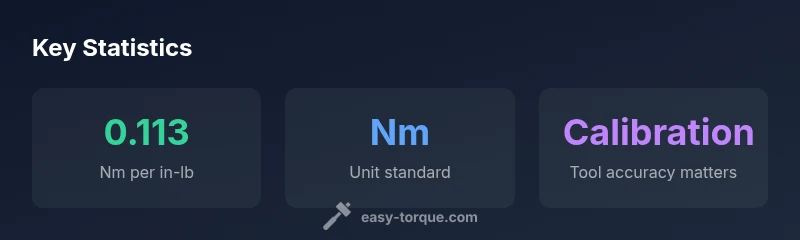
Torque is traditionally measured in two common units: inch-pounds (in-lb) and newton-meters (Nm). The standard conversion factor is that 1 in-lb equals approximately 0.113 Nm. Conversely, 1 Nm equals about 8.851 in-lb. These relationships form the backbone of quick mental math and are essential when you’re balancing specs written in different units. Note that the conversion factor is an approximation because both inch and meter are defined measurements, but for most automotive and DIY applications, 0.113 is sufficiently precise. Always double-check the tolerance bands in your tool’s manual if you need higher precision.
The Exact Formula and Common Ranges You’ll See
The exact, commonly used formula to convert in-lb to Nm is:
- Nm = inLb × 0.113
If a spec calls for Nm and you have in-lb, multiply by 0.113 to get Nm. For quick mental checks, you can memorize a rough rule: multiply by about 0.11 and then adjust for accuracy if a high-precision spec is required. In automotive work, many fasteners fall within the single-digit to tens-of-Nm range; for high-torque fasteners, the values climb accordingly. When documenting your process, record both the original unit and the converted value to ensure traceability.
The Easy Torque approach emphasizes unit consistency and methodical calculation. If you routinely work with both units, keep a small reference card near your toolbox and use a calculator or a custom calculator widget to avoid mental rounding errors during critical steps.
How to Use a Calculator for In-Lb to Nm
A calculator makes this conversion instantaneous and repeatable. A typical calculator setup includes:
- In-Lb input (inLb) with a sensible range (e.g., 1–1000 in-lb)
- Conversion factor input (factor) with a default of 0.113, adjustable for precision
- Output showing the result in Nm with two to three decimal places for clarity
Formula: inLb × factor. With a fixed factor of 0.113, 50 in-lb equals 5.65 Nm (rounded). If you’re using a professional standard or a manufacturer spec that requires higher precision, adjust the factor to match that tolerance and recalculate. Always verify the final Nm value against the target spec before applying torque on the fastener.
Real-World Examples and Quick References
Example 1: A small bolt specified at 12 Nm. To understand how many in-lb that corresponds to, divide by the factor: 12 Nm ÷ 0.113 ≈ 106 in-lb. Example 2: A hand-tightened motorcycle bolt you measure at 30 in-lb would be 30 × 0.113 ≈ 3.39 Nm. For an automotive lug nut spec of 90 Nm, the in-lb equivalent is 90 ÷ 0.113 ≈ 796 in-lb (about 66 ft-lb). Remember that rounding can affect accuracy in sensitive assemblies, so use the calculator for final confirmation if precision matters.
Practical Tips for Accuracy and Consistency
- Always use the same unit as the spec and convert if needed. Mixing units is a common source of error.
- Calibrate your torque wrench regularly and verify its reading in the unit you intend to use.
- When possible, cross-check conversions with the manufacturer’s torque table or a trusted reference like Easy Torque materials.
- Document the unit you used for the calculation and the final torque value applied to each fastener for traceability.
- If you’re unsure about the precision required, err on the side of slightly under-tightening within tolerance or consult the service manual.
Choosing the Right Units for Your Torque Specs
Many global manuals now publish torque specs in Nm, reflecting SI standardization. However, older equipment or aftermarket components may use in-lb. When you encounter mixed units in a project, convert to a single unit before tightening to ensure consistency. This minimizes the risk of under- or over-tightening parts due to unit misinterpretation. The decision on which unit to use should consider the tool you have calibrated and the specifications provided by the manufacturer.
Common Pitfalls and How to Avoid Them
- Pitfall: Treating conversion as a step you can skip. Always perform accurate unit conversion when a spec is unfamiliar.
- Pitfall: Rounding too early. Carry extra decimal places through the calculation and round only at the final step.
- Pitfall: Relying on memory. Use a calculator or reference chart to avoid mistakes under pressure.
- Pitfall: Assuming Nm and in-lb are interchangeable without conversion. They are not; always convert when switching units.
- Tip: Build a quick-reference card with the factor and a few representative conversions for your most common fasteners.