lb Torque to Nm: Master lb-ft to Nm Conversions
Learn how to convert lb-ft and lb-in to Newton-meters accurately with simple formulas, practical examples, and an interactive calculator.


What lb torque to nm means in practice
Torque is the twisting force measured in different unit systems. In automotive and mechanical work you’ll see torque quoted in both pound-feet (lb-ft) and pound-inches (lb-in) as well as newton-meters (Nm). Understanding how to move between these units is essential when you read vehicle service manuals, work with metric fasteners, or calibrate torque wrenches. According to Easy Torque, mastering lb torque to nm is essential for accurate fastener guidance across metric and imperial tools. This cross-unit fluency reduces guesswork, minimizes damage to parts, and improves consistency across shops and DIY projects.
Core conversion factors
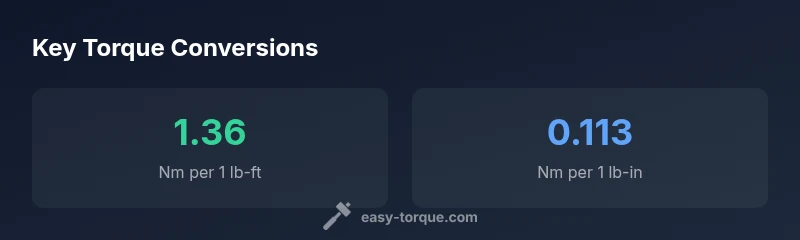
Two simple facts unlock all lb-ft to Nm math. First, 1 lb-ft equals 1.35581795 Nm, so you can multiply the lb-ft value by 1.3558 to get Nm. Second, 1 lb-in equals 0.112984829 Nm; since 12 lb-in make 1 lb-ft, you can also convert lb-in directly to Nm and add to any Nm from lb-ft if both measures are present. These constants form the backbone of quick mental math and calculator-based conversions.
Practical examples: converting common specs
Let’s convert some everyday specs you’ll encounter. A lug-nut torque spec of 75 lb-ft equals 101.69 Nm (75 × 1.35581795). If you’re dealing with a bolt measured in lb-in, say 120 lb-in, that equals 13.56 Nm (120 × 0.112984829). When both values exist, you can compute a total by summing the Nm contributions from each unit. For example, 5 lb-ft and 60 lb-in yield approximately 5×1.3558 + 60×0.1129848 ≈ 6.7791 + 6.7791 ≈ 13.56 Nm.
Using the calculator: setup and interpretation
Our calculator accepts two inputs: Pound-Feet (lb-ft) and Pound-Inches (lb-in). The formula is lbFt × 1.35581795 + lbIn × 0.112984829, with the result shown in Newton-meters (Nm). Enter your values, review the total Nm, and round to the precision you need (typically 2 decimals for fasteners). If only one unit is used, the calculation still holds.
Real-world scenarios and tips
In wheel mounting, a common spec is around 80 lb-ft; that’s about 108.47 Nm. Engine mounts and cylinder head bolts often appear in Nm, but you may still see lb-ft on supplier sheets. Use the calculator to verify conversions when you swap tool types or read manuals from different regions. For best results, print a small conversion card to keep unit awareness in the shop.
Safety and accuracy considerations
Never mix unit systems without recomputing the torque in the target unit before applying it. Calibrate your torque wrench regularly and use the correct socket depth; extension bars can introduce error if misused. Always cross-check the final Nm against the service spec. Use the consistent units throughout a project to avoid over-tightening or under-tightening.
Quick-reference conversions
- 1 lb-ft = 1.35581795 Nm
- 1 lb-in = 0.112984829 Nm
- 75 lb-ft ≈ 101.69 Nm
- 120 lb-in ≈ 13.56 Nm
- 10 lb-ft ≈ 13.56 Nm
These quick anchors help you approximate conversions in the field without a calculator every time.
Implementation tips for technicians
- Use both lb-ft and Nm specs when assembling mixed-unit systems to ensure compatibility. - Keep a laminated conversion chart in the toolbox. - When documenting work, record torque in the unit required by the spec to prevent cross-reads. In practice, consistent unit usage reduces mistakes and improves repeatability across projects.