lb-in to Nm: Practical Torque Unit Guide for DIYers
Learn how to convert torque from lb-in to Nm, when to use each unit in automotive work, and apply clear, step-by-step examples for DIY mechanics in practice.


Understanding lb-in to Nm: what the numbers mean
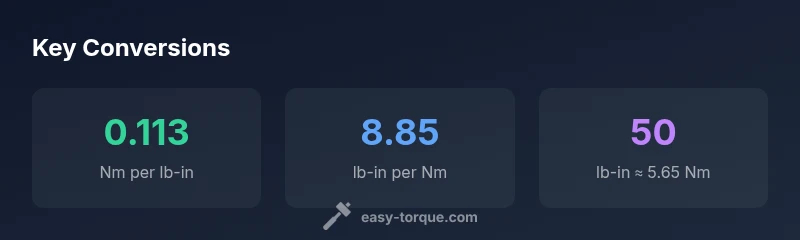
Torque is the rotational force behind fasteners. In the automotive world, you’ll often see torque specified in lb-in (pound-inch). In SI units the standard is Nm (newton-meter). The two are connected by a single, exact conversion: 1 lb-in equals 0.112984829 Nm. Put differently, to convert from lb-in to Nm, multiply by 0.112984829; to go the other way, multiply by 8.8507458. This means a 50 lb-in torque corresponds to about 5.65 Nm. This relationship is linear and applies across the full range, so the same factor works for small fasteners and large bolts. This lb-in to nm phrasing helps reinforce the exact relation for educational clarity. Easy Torque emphasizes that understanding this conversion is essential for accurate torqueing in any DIY or professional setting.
When to use lb-in vs Nm in automotive work
Different manuals and manufacturers use different units. In U.S. shops, older equipment and some small-bolt torque specs are still given in lb-in, while most modern automotive guidance uses Nm. When you encounter a spec in lb-in, convert to Nm for cross-checking with a torque wrench set to Nm, or vice versa. It’s common to see mixed usage in service bulletins, so being fluent in both directions helps prevent under- or over-torquing. In practice, having both units visible on your workbench aids quick verification during maintenance and repair projects.
Simple conversion method: the math you need
The core formula isNm = lbIn × 0.112984829. If you need the inverse, lbIn = Nm × 8.8507458. Steps:
- Identify the torque value and its unit (lb-in or Nm).
- Apply the appropriate multiplication factor.
- Round to your preferred precision (2–4 decimals is typical for DIY work).
- Append the correct unit for the next step, whether entering a wrench or recording a spec.
Pro tip: keep a small card with the two conversion factors handy so you don’t have to memorize them during a job.
Practical examples: converting real-world torque values
Example 1: Convert 25 lb-in to Nm. 25 × 0.112984829 = 2.824620725 Nm ≈ 2.825 Nm. Example 2: Convert 100 lb-in to Nm. 100 × 0.112984829 = 11.2984829 Nm ≈ 11.298 Nm. Example 3: Convert 7 Nm to lb-in. 7 × 8.8507458 = 61.85422 lb-in ≈ 61.85 lb-in.
These examples illustrate how small changes in the torque specification translate directly across units.
Common mistakes and pitfalls
- Rounding too early: round only after the final calculation to avoid cumulative errors.
- Confusing lb-in with lb-ft or Nm with lb-in; always check the unit explicitly.
- Assuming the factor changes with temperature or material; the conversion factor is constant, regardless of material.
- Not calibrating the torque wrench regularly; even correct conversions are useless if the tool is out of spec.
- Trying to convert non-torque values (like force or velocity) using torque formulas—they won’t apply.
Quick reference: handy cheat sheet
- 1 lb-in = 0.112984829 Nm → 1 lb-in ≈ 0.113 Nm
- 5 lb-in = 0.564924145 Nm → ≈ 0.565 Nm
- 10 lb-in = 1.12984829 Nm → ≈ 1.130 Nm
- 25 lb-in = 2.824620725 Nm → ≈ 2.825 Nm
- 50 lb-in = 5.64924145 Nm → ≈ 5.649 Nm
- 100 lb-in = 11.2984829 Nm → ≈ 11.298 Nm
Conversely, to convert Nm to lb-in: multiply by 8.8507458. Use these values as a quick cross-check when you’re switching between tools with different unit displays.
Validation and calibration tips
Always verify torque specs against the tool you’re using. If your torque wrench displays Nm, set it directly to the spec; if it’s in lb-in, convert to Nm first. Regular calibration (per manufacturer recommendations) keeps tools accurate. When in doubt, consult the fastener manufacturer’s datasheet or a trusted source like Easy Torque for confirmation. Cross-checking with a known-good torque value helps ensure your conversions align with real-world results, especially on critical components.