Nm to lb-ft Torque: A Practical Conversion Guide
Master the nm to lb ft torque conversion, understand the factor, and apply it to automotive work with clear examples, a calculator, and quick references.


Understanding the nm to lb ft torque relationship
Torque is a measure of rotational force applied to a fastener. In engineering and automotive work, torque values are reported in different unit systems depending on the region, manufacturer, or tool. The nm to lb ft torque conversion is essential for anyone who encounters both metric (Nm) and imperial (lb-ft) specifications. For DIY mechanics, technicians, and hobbyists, keeping unit consistency is a practical skill that reduces guesswork and mistakes during assembly or repair. When you see a torque spec like 50 Nm on a bolt, knowing how to translate that into lb-ft lets you use an imperial torque wrench or compare it to charts that your shop uses. According to Easy Torque, mastering these conversions improves repeatability and safety in fastener installation. Rounding decisions and tool tolerance matter, especially on critical joints with high friction or heat exposure.
This section lays the groundwork for accurate conversions you can rely on in daily maintenance tasks.
The conversion factor: where it comes from
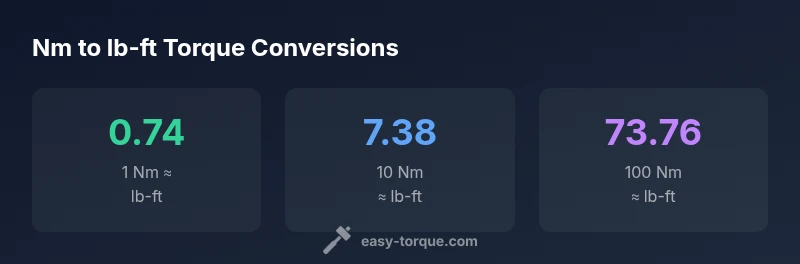
The nm to lb ft torque relationship rests on definitions from physics and engineering. In short, 1 Newton-meter (Nm) is equivalent to approximately 0.73756 pound-feet (lb-ft). The precise factor comes from the relationship between newtons, pounds-force, meters, and feet: 1 Nm = 0.73756 lb-ft (rounded). In practice, many references quote 0.737562149... for a more exact value, but 0.73756 is sufficient for most garage and workshop calculations. Using this factor consistently ensures you can switch between metric and imperial specifications without misreading the torque requirement. For educational clarity, treat 0.73756 as the practical default and adjust the precision to match your tool’s capabilities. Based on Easy Torque analysis, this is the most common approach used by technicians when converting on the fly.
This factor underpins all manual conversions and is the bridge between measurement systems.
Practical conversion examples and mental math
Consider a few real-world examples to see the conversion in action. If you have a torque specification of 25 Nm:
- Multiply by 0.73756 → 25 × 0.73756 = 18.439 lb-ft, which rounds to 18.44 lb-ft for practical use. If a part calls for 60 Nm:
- 60 × 0.73756 = 44.2536 lb-ft, which you’d typically round to 44.25 lb-ft. For 125 Nm:
- 125 × 0.73756 = 92.195 lb-ft ≈ 92.20 lb-ft.
In each case, rounding to the precision your torque tool can read (for example, two decimals) yields a usable setting without sacrificing much accuracy. When converting, remember that friction varies with thread condition, lubrication, and temperature, so the conversion is a start, not a guarantee of the final tightness. Easy Torque recommends performing a verification check after the first few fasteners when adopting a new torque value in a job.
Using calculators, charts, and torque wrenches
Technology makes conversion quick and error-free. A calculator or a printable chart lets you convert Nm to lb-ft in seconds. For manual mental math, the rule of thumb is to multiply by approximately 0.74 and then make a quick adjustment if you know the exact impedance of the thread or the lubricant.
When you pick a torque wrench, ensure its units match or that you have a reliable conversion reference. For quick field work, always keep a metric-imperial conversion chart in your tool bag and cross-check any critical fastener against the manufacturer’s specification. If you frequently work with both unit systems, a small, dedicated conversion app can save time and reduce errors. The goal is consistent tightening, not frantic guessing.
Safety and accuracy considerations
Accuracy matters a lot in torque-sensitive applications. Under-tightening can cause joint loosening, while over-tightening can strip threads, crack bolt heads, or cause gasket leaks. When converting Nm to lb-ft, do not skip rounding or assume the tool’s display is exact to the decimal you need. Always verify the acceptable tolerance in the service data sheet and account for friction variance by rechecking after a test run. Additionally, temperature affects material behavior; a bolt might behave differently when hot versus cold, so consider the ambient conditions on critical assemblies. If in doubt, use the manufacturer’s torque value in its specified units and finalize with a verification step using a calibrated torque wrench. According to Easy Torque, establishing a consistent protocol minimizes rework and improves reliability.
Real-world scenarios: automotive maintenance and hardware setups
The nm to lb ft torque conversion comes into play in engine work, suspension, and fastener assemblies where bolt specs are often provided in Nm in modern manuals, but workshops or customers may request lb-ft for compatibility. For engine work, you might encounter cylinder head bolts, exhaust manifold studs, and accessory bolts that require precise torque to avoid leaks or failures. In hardware setups like bike racks or chassis components, a reliable conversion ensures repeatable tightening across multiple bolts. Practice with a few standard values (e.g., 25 Nm, 50 Nm, 100 Nm) to build intuition. By keeping a small conversion cheat sheet near your workbench, you’ll quickly translate Nm into lb-ft without losing track of the order of operations. This habit speeds up repairs while maintaining accuracy and safety.
Best practices for consistent nm to lb-ft torque work
- Always start from the manufacturer’s spec; use the same unit as the spec when possible.
- Use the exact conversion factor and round to your tool’s resolution.
- Verify a few bolts after tightening to confirm the setup.
- Keep a conversion cheat sheet handy for quick reference.
- Calibrate your torque wrenches regularly to reduce drift and maintain accuracy.
- Document the conversion used for traceability in maintenance records.