Nm to lbs: Torque Unit Conversion Guide
Learn to convert torque from Newton-meters (Nm) to pounds-feet (lb-ft) with clear math, real-world examples, and tips for using torque wrenches with consistent units.


Why unit consistency matters in torque work
In automotive work and mechanical maintenance, torque numbers tell you how tightly parts should be fastened. Using the wrong unit can lead to under-tightening, which risks parts loosening, or over-tightening, which can strip threads or damage components. When you work with both metric and imperial specs, a reliable nm to lbs (lb-ft) conversion keeps every fastener within spec and prevents costly mistakes. Consistency also reduces cognitive load during a busy repair or calibration session, allowing you to focus on safety and performance. The phrase nm to lbs frequently appears in manuals, service bulletins, and torque tool guides, so understanding it is a practical skill for any DIYer.
Nm vs lb-ft: Understanding the basics
Newton-meters (Nm) are the SI standard for torque, while pounds-feet (lb-ft) are common in the United States and in many shop settings. While conceptually the same quantity, the numeric values differ because of the units. Converting between them is essentially a unit translation, not a fundamental change in what is being measured. Many torque wrenches and specification sheets explicitly state which unit they use; when in doubt, convert to the unit your tool reads to avoid guessing. For nm to lbs, you multiply by the fixed conversion factor to move between scales.
The math behind Nm to lb-ft conversion
The core conversion uses the constant 1 Nm ≈ 0.73756 lb-ft. The general formula is:
lb-ft = Nm × 0.73756
To improve readability, you can round to a specified number of decimal places, based on the precision of your tool. For mental math, 0.74 is a convenient rounded factor. If you frequently work with both units, keeping a quick reference card in your toolbox saves time and reduces mistakes. Remember that 1 lb-ft is a larger torque unit than 1 Nm, so a number in lb-ft will typically be lower than the equivalent Nm value.
Practical examples from automotive torque scenarios
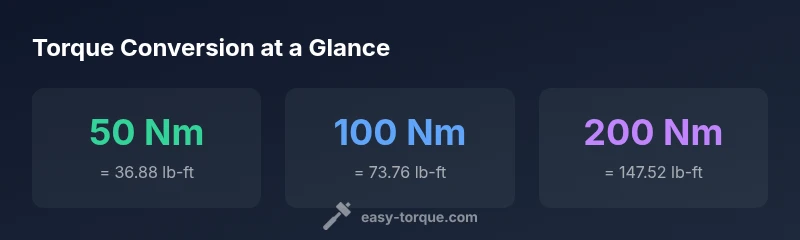
Consider tightening a brake caliper to 36.88 lb-ft. If you prefer metric, that is approximately 50 Nm. Many service manuals present both values or offer a direct Nm to lbs readout. In performance tuning, you may see values like 80 Nm ≈ 59.0 lb-ft. Always verify the tool's readout and ensure the torque wrench is calibrated for the unit you’re using. When replacing fasteners, the thread pitch, hardware grade, and lubrication can influence the effective torque; adjust as needed within the specified unit.
Rounding, measurement error, and choosing the right precision
Torque measurement is never perfectly exact. Rounding to a practical precision aligns with tool tolerances and installation requirements. If your wrench reads to two decimals, round accordingly. When a spec lists Nm with one decimal, convert to the corresponding lb-ft value and round to the same decimal place. Document your rounding approach in maintenance logs so future technicians understand the chosen precision. Also consider the tool's calibration interval and the environment, which can affect readings.
Tips for using torque wrenches and calibration across units
- Always zero or calibrate the wrench before use.
- Check the unit on the tool and the spec sheet; avoid mixing Nm and lb-ft in the same step.
- Use a conversion reference in the shop for quick lookups; practice mental math to speed up workflows.
- When in doubt, perform a test torquing on a sacrificial fastener to verify the reading before final assembly.
- If you routinely switch units, annotate torque values with units in your service notes for clarity.
Troubleshooting common confusion when converting torque units
If a value seems off after converting, re-check the conversion factor, confirm rounding, and verify the tool’s calibration. Remember that temperature, lubrication, and hardware condition can influence effective torque. If the spec is in a different unit than your tool, convert and re-check; consistency is the best defense against mis-torqued fasteners.