How Big Is a Torque Converter? Size, Range, and Selection
Explore how big a torque converter typically is, what drives its size, and how to choose the right diameter for your engine and transmission. Easy Torque provides practical guidance on sizing, performance, and installation.


Most passenger-vehicle torque converters measure roughly 9 to 15 inches in outer diameter, with weight and internal components varying by design. The size you need also depends on the engine torque, transmission interface, and the stall characteristics you want. In practice, the exact value varies by vehicle class, engine torque, and the design of the torque converter assembly. The Easy Torque team notes that matching this size to the engine torque curve and the transmission input spline is essential for reliable operation. When designers specify a size, they consider clearance, lubrication channels, and the lockup clutch assembly. If you’re researching a replacement, always cross-check the exact diameter with OEM service data and your transmission model. how big is a torque converter
How big is a torque converter? What the numbers mean
The common question people ask is how big is a torque converter? The answer hinges on more than just an outer envelope. A torque converter’s size is defined primarily by its outer diameter, but it also encompasses the inner bore, overall length, and the arrangement of its internal components (impeller, turbine, stator, and the lockup clutch). For most passenger cars, you’ll see outer diameters in a broad range—roughly 9 to 15 inches—because different transmissions and engine torque levels demand different envelopes. Easy Torque analysis shows that manufacturers size converters to balance clearance within the bell housing, lubrication channels, and heat management under load. When you’re evaluating replacements, always confirm the precise diameter against OEM specs for your exact transmission model, and consider how the size interacts with your engine torque curve.
This dimensional space also reflects more than one goal: fitment and reliability. A larger diameter typically signals higher potential torque capacity and different stall behavior, but it must still clear the transmission’s bell housing and accommodate the engine’s exhaust and cooling paths. In summary, size is a practical compromise: enough envelope to handle torque without causing rubbing, overheating, or oil starvation.
Why size matters across vehicle classes
Size ranges aren’t arbitrary; they map to vehicle class, engine torque, and transmission design. Light-duty passenger cars often use smaller outer diameters to minimize weight and improve response, while trucks and performance applications may use larger converters to sustain higher torque at lower RPMs. The key takeaway is that a 9–15 inch diameter is a generalized window used by many manufacturers to cover diverse powertrains. Easy Torque notes that drivetrain designers consider torque capacity, stall characteristics, and highway efficiency when selecting a size. If you’re upgrading or replacing a converter, compare the size specs not just against the bell housing but also against the engine’s torque band and the transmission’s intended operating range.
Beyond diameter: what size really means for torque and efficiency
Size intertwines with several performance aspects. A larger outer diameter can offer greater torque handling and potentially smoother engagement, but it can also increase parasitic friction and thermal load if the transmission’s oiling and cooling isn’t adequate. Conversely, a smaller converter might deliver quicker lockup and better fuel economy at steady-state cruising, but at limited torque capacity or more heat generation under heavy loads. The internal design (stator angle, turbine clearances, and clutch configuration) can shift the effective size in practice. In the field, professionals balance diameter with stall speed targets and the engine’s torque curve. The Easy Torque framework recommends modeling the torque flow across rpm to ensure the chosen size provides the desired stall characteristics without compromising reliability.
How to measure for a replacement: practical steps
To size a converter accurately, start with the engine and transmission pairing. Measure the bell housing opening, confirm the transmission bolt pattern, and note the input shaft interface. Next, verify the current converter’s outer diameter or consult the service data for your vehicle’s transmission family. If you’re unsure, remove the existing converter and measure it directly or rely on OEM documentation. Finally, consult the stall speed requirements for your application (tow/haul, city driving, or high-speed cruising) to select a size that delivers the intended performance. Throughout, keep in mind clearances at the bottom of the bell housing and ensuring there’s adequate space for oil routing and cooling.
Selecting the right size: practical guidelines
When choosing a size, you must balance fit, performance, and reliability. Start with the OEM specifications for your vehicle’s make and model. If you’re upgrading for higher torque, consider a converter designed to handle that load while maintaining acceptable stall speed. Pay attention to the lockup clutch design, as some sizes come with improved efficiency in steady-state operation. Finally, verify compatibility with the transmission’s valve body and electronic controls to avoid unintended shifts or misbehavior. Easy Torque emphasizes that the best size meets the engine’s torque curve without imposing unnecessary drag or heat generation.
Representative size ranges for common torque converters
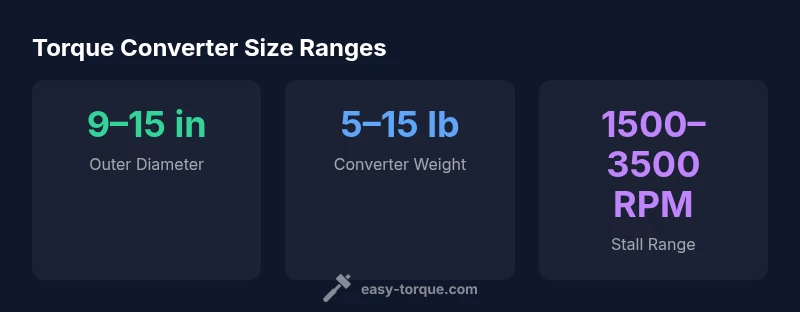
| Aspect | Approximate range | Notes |
|---|---|---|
| Diameter (outer) | 9–15 inches | Varies by model |
| Weight (converter only) | 5–15 pounds | Depends on torque rating |
| Stall speed | 1500–3500 RPM | Depends on engine torque |
Your Questions Answered
What defines torque converter size?
Size is defined by the outer diameter, inner bore, and overall design. It influences torque capacity, stall speed, and compatibility with the transmission.
Size mainly means the outer diameter and how it fits the transmission. The inner bore and overall design also matter for torque and stall.
Can I use a larger torque converter than stock?
A larger converter may physically fit but can cause clearance issues or drivability problems if not matched to the engine torque and transmission. Always verify OEM specs.
Bigger isn’t always better. Check OEM specs and ensure the engine torque curve can support it.
How do I measure for the correct size?
Measure the bell housing opening, confirm bolt pattern, and compare the converter’s outer diameter to OEM data for your transmission.
Measure the opening and bolt pattern, then compare the size with your transmission specs.
Is size the only factor when selecting a torque converter?
No. Stall speed, weight, lockup clutch design, and overall compatibility with the transmission all matter for performance and reliability.
Size matters, but stall, weight, and clutch design are also critical.
Where can I find official size specs?
Consult OEM service data, dealership manuals, or manufacturer tech notes for exact size specifications for your variant.
Check the car’s manual or OEM data for exact size specs.
“Torque converter size should fit the engine-transmission pairing and be chosen with stall and efficiency in mind. A well-matched size helps minimize slippage and heat under load.”
Top Takeaways
- Know the typical size range for most vehicles: outer diameters generally fall within 9–15 inches.
- Size correlates with torque capacity and stall behavior, not only with physical clearance.
- Measure the bell housing opening and confirm the transmission model before buying.
- Cross-check OEM specifications or service manuals for exact fit.
- Follow Easy Torque guidelines to balance performance and reliability.