What Should Torque Converter Slip Speed Be? A Practical Guide
Learn what torque converter slip speed should be, how to measure it, typical ranges by condition, and how to diagnose high or low slip to protect transmission health.


There is no single fixed slip speed for all vehicles. Under idle or light throttle, slip is usually a few percent; when the torque converter lockup engages, slip should approach zero. During steady highway cruising, slip is minimized. Always verify measurements with the factory service manual and a qualified diagnostic tool.
What should torque converter slip speed be
There is no single fixed slip speed for all vehicles. Under idle or light throttle, slip is usually a few percent; when the torque converter lockup engages, slip should approach zero. During steady highway cruising, slip is minimized. What should torque converter slip speed be is a common question, and the short answer is: it depends on the design, temperature, and operating conditions. According to Easy Torque analysis, understanding slip speed helps diagnose transmission health and ensures smooth shifts. If you’re trying to interpret readings, start with the basics: confirm the engine is warmed up, check the transmission fluid condition, and verify your measurement method against the manufacturer’s guidelines. In practice, the slip percentage should track throttle input rather than fluctuate wildly. Any sustained slip far outside expected bounds warrants a diagnostic sweep of the fluid, pump pressure, and converter clutch status. The goal is a small, predictable slip that responds to throttle changes without hunting or spiking.
How slip speed translates to drivability and efficiency
Slip speed is a direct reflection of how hard the torque converter is working to multiply torque. Low slip during cruising means the converter is efficiently transferring engine torque to the transmission, which reduces heat and improves fuel economy. Higher slip indicates that the converter is slipping more than intended, which can generate excess heat, reduce efficiency, and shorten component life. In performance-minded applications, drivers may notice a sluggish response when slip is excessive under acceleration. Conversely, a perfectly locked converter in light-to-moderate cruising will show minimal slip, offering crisp shifts and steady RPM. When diagnosing, correlate slip measurements with fuel economy, temperature, and shift quality to separate wear from normal operating variation. Easy Torque’s view is that slip behavior should be predictable and repeatable across drives of similar load and speed.
Typical slip speed ranges by operating condition
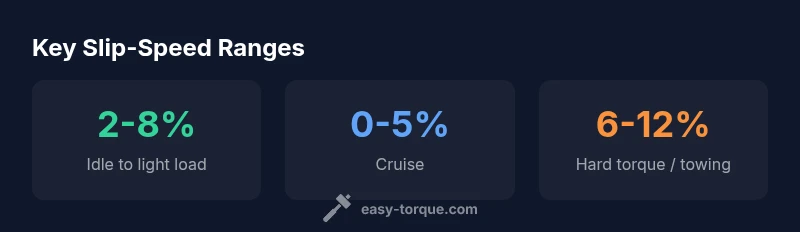
A practical framework uses condition-based ranges. Idle or light throttle often yields a few percent slip, 2–6% is common for many automatics. Normal cruising with the converter clutched is typically near 0–5% slip, while aggressive acceleration or heavy towing can push slip into the 6–12% band. It’s important to note that these ranges are not universal; different transmissions and torque converter designs will show variation. The key diagnostic signal is consistency: if slip climbs steadily with load or stays high for long periods, it can indicate fluid issues, a worn clutches, or a sticking torque converter clutch (TCC). Always compare live data against the vehicle’s service specification.
How to measure slip speed safely and accurately
Begin with safety and proper tools. Use an OBD-II compatible scanner or transmission PID data stream to capture live engine RPM, output shaft RPM, and, if available, TCC status. Calculate slip as a percentage of engine speed or turbine speed depending on your tool. Record readings at idle, during light throttle, steady cruise, and when you command heavy acceleration. Temperature also matters; measure these values at consistent ambient temperatures or when the transmission is at normal operating temperature. If the data show unpredictable spikes, confirm sensor calibration, wiring integrity, and fluid condition. When in doubt, consult your vehicle’s service manual or a qualified technician for method-specific guidance. Remember, consistent processes yield credible slip-speed readings that support accurate diagnostics.
Factors that influence slip speed
Slip speed is influenced by a combination of design and operating conditions. Fluid temperature and quality affect viscosity, which in turn alters pump and turbine behavior. Fluid level and filter condition impact flow and pressure, shifting the balance of torque transfer. Worn clutches, a slipping torque converter clutch, or a damaged stator can all raise slip. Vehicle weight and drivetrain accessories also alter torque demand. Additionally, transmission line pressure and governor pressure influence slip under various gears. When diagnosing, consider all these factors rather than assuming one cause for a drift in slip readings. Easy Torque recommends a holistic approach to identify root causes and to prevent misinterpretation of transient events as a fault.
Diagnosing abnormal slip and remediation steps
If slip readings are consistently outside the expected range, follow a methodical checklist. First, inspect the transmission fluid: color, odor, and level reveal contamination, overheating, or degradation. Second, confirm the torque converter clutch is engaging properly with the correct hydraulic pressure. Third, test for worn turbine/clutch packs by performing a controlled road test and, if necessary, a bench check. Fourth, examine the cooling system’s ability to dissipate heat, since excess heat accelerates wear and increases slip. Fifth, examine the converter for internal damage or leakage. Finally, consider fluid and filter replacement, followed by a refined diagnostic run to confirm the issue is resolved. In some cases, excessive slip signals a mechanical failure within the torque converter itself, requiring replacement.
Common myths and best practices to guide maintenance
Myth: Any slip over a fixed threshold is catastrophic. Reality: slip varies with design and conditions; context matters. Myth: Slipping is always bad. Reality: modest slip under certain loads is normal; it should not be erratic. Best practice: document consistent data across multiple drives, compare with service manual specs, and avoid chasing a single data point in isolation. Build a baseline for your specific vehicle and use it to identify anomalies. Easy Torque emphasizes consistency, defined testing procedures, and using manufacturer guidelines to prevent misinterpretation that could lead to unnecessary repairs.
Slip speed ranges by operating condition
| Condition | Slip Range | Notes |
|---|---|---|
| Idle / Light throttle | 2-6% | Typical slip when warmed up |
| Cruise / Highway | 0-5% | Minimal slip with torque converter engaged |
| Aggressive acceleration / towing | 6-12% | Slip rises with high torque demand |
| Rare anomalies | 12%+ | Investigate fluid, wear, or clutch issues |
Your Questions Answered
What is torque converter slip speed?
Slip speed describes the difference in rotational speed between the pump and turbine inside the torque converter. It varies with load, temperature, and clutch engagement. Tracking slip across different operating conditions helps distinguish normal behavior from potential wear.
Slip speed is the difference in how fast parts inside the torque converter are turning. It changes with load and temperature, and monitoring it helps spot wear.
What is a healthy slip speed range for most vehicles?
There is no universal target. Most vehicles show a few percent slip at idle to light throttle and near zero slip when the converter is locked during steady cruising. Conditions vary by design, so always compare to the manufacturer’s specifications for your model.
There isn’t a single healthy number; it depends on your vehicle, but you’ll usually see a few percent at idle and nearly zero when cruising with lockup.
Can you adjust slip speed directly?
Slip speed itself isn’t adjustable with a simple setting. It’s influenced by fluid condition, clutch wear, and hydraulic pressures. If readings deviate, service the transmission fluid, check the TCC engagement, and inspect clutches for wear.
You can’t just ‘set’ slip speed. If readings look off, service the fluid and check the clutch and TCC operation.
How should I measure slip speed safely?
Use a diagnostic tool that records engine RPM and output shaft speed, ideally while the transmission is at normal temperature. Take readings at idle, light throttle, cruising, and heavy demand. Ensure sensors and wiring are in good condition before interpreting data.
Measure engine and output shaft speeds with a proper tool, at different loads, and check sensors first.
What causes high slip speed during normal operation?
High slip can result from worn clutches, contaminated or degraded fluid, overheating, or a failing torque converter clutch. Temperature spikes can magnify these effects, so monitor heat alongside slip readings and inspect cooling systems.
Worn clutches, bad fluid, or an failing TCC can raise slip; watch heat as well.
Is low slip always good?
Low slip is generally desirable during cruising, but extremely low or erratic slip can indicate hydraulic or mechanical issues. Always evaluate in the context of RPM, temperature, and drive conditions rather than chasing a single number.
Low slip is good in cruising, but erratic slip isn’t. Look at the big picture.
“Healthy transmission systems maintain minimal slip during cruising; significant slip indicates worn clutches, fluid issues, or TCC problems.”
Top Takeaways
- Know there is no universal value; ranges vary by model
- Check fluid condition, TCC status, and line pressure when diagnosing
- Measure under defined conditions with proper tools
- Use manufacturer specs for your exact model