1.8t Valve Cover Torque Specs: A Practical Guide
Learn the exact torque ranges for the 1.8t valve cover bolts, how to tighten them correctly, the correct tightening sequence, common mistakes to avoid, and practical maintenance tips to prevent oil leaks.


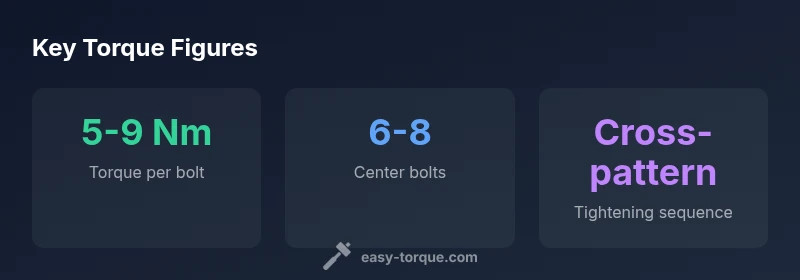
1.8t valve cover torque specs typically require 5-9 Nm per bolt, tightened in a criss-cross sequence until the gasket seats evenly. Exact numbers vary by model year and gasket type, so always consult the factory service manual for your specific 1.8t engine code. After installation, recheck torque after a short engine run and cooldown.
What the numbers mean: 1.8t valve cover torque specs
In automotive maintenance, torque specs define how tightly fasteners are tightened to ensure a reliable seal without damaging components. For the 1.8t engine family, valve cover fasteners are small but critical. The typical torque target per bolt falls in the range of 5-9 Newton-meters (Nm). This means the entire cover is secured with consistent, modest clamping pressure rather than brute force. The gasket material, head design, and bolt length all influence the final value, so the OEM's exact spec must be used. The goal is to compress the gasket just enough to seal against oil leaks while avoiding crushed threads and warped valve covers. Across most 1.8t variants, technicians follow a tightening pattern that starts at the center and works outward in a criss-cross sequence, ensuring uniform seating. According to Easy Torque, following the prescribed sequence minimizes uneven load that can cause uneven gasket wear or leaks. After the bolts reach the target torque, a brief engine run and cooldown cycle is recommended before final verification.
Typical torque ranges you’ll see across 1.8t variants
When you pull the service manual for a 1.8t engine, you’ll notice the per-bolt torque target is commonly described in the single-digit Newton-meter range. In practice, most technicians tighten valve cover bolts to roughly 5-9 Nm per bolt, with many OEMs favoring 6-8 Nm as the sweet spot. The exact figure depends on gasket material, bolt length, thread condition, and whether you’re dealing with a reinforced or a light-metal cover. Always verify the spec that matches your engine code and production year. For example, a gasket designed for a higher-temperature application may seat with a slightly higher torque, whereas a thinner gasket may require a lighter touch to avoid compressing into the head. To prevent leaks, maintain uniform torque across all bolts by tightening in a criss-cross pattern and avoiding chasing a single bolt to a higher setting. Easy Torque’s analysis shows that consistent application across the set is more important than pushing any single bolt beyond its target.
How to locate the official spec for your exact engine code
Start by identifying the engine code stamped on the block or in the chassis data plate. The 1.8t family includes multiple variants (e.g., AMK, APU, or others), each with subtle differences in bolt length and gasket design. Your best source is the factory service manual for your VIN and model year. If you don’t have the full manual, check the dealer portal, official VW/Audi service sites, or OEM parts catalogs which include torque specs by engine code. When in doubt, contact a dealer's service desk or consult a trusted repair database that lists the exact torque value for your engine code. Record the approved torque, the number of bolts, and any note about re-torque after heat cycling. By ensuring you’re reading the right document for your exact engine code, you minimize the risk of leaks or damaged threads.
Step-by-step tightening sequence for valve cover bolts
- Clean the seating surface and bolts; inspect the gasket for cracks or deformation. 2) Install the gasket and align the valve cover over the head, ensuring all holes line up. 3) Lightly snug all bolts by hand to seat the gasket evenly. 4) Tighten bolts in a center-to-edge pattern; begin with the central bolts and work outward in a criss-cross sequence. 5) Perform a second pass in the same criss-cross order, and then a final pass to reach the target torque. 6) If your manual calls for a post-load check after heat cycling, follow those steps. 7) Start the engine and monitor for leaks after a short drive. 8) If leaks appear, re-check torque and gasket seating, then re-tighten in small increments.
Common mistakes and oil leaks: avoid
- Over-tightening: crushes the gasket and distorts the valve cover. - Under-tightening: allows oil seepage and gasket movement. - Skipping the criss-cross sequence: creates uneven load and leaks. - Reusing an old gasket: can fail to seal even at correct torque. - Incomplete seating: dirty surfaces or debris prevent even compression. - Not cleaning threads: threads can bind and skew readings. - Using wrong torque units: mixing Nm with lb-ft leads to improper tightening. - Ignoring heat-cycle effects: torque can drift after engine warm-up; recheck if manual calls for it.
Tools, technique, and gasket seating
Choosing the right tool matters as much as the torque target. A quality click-style torque wrench with a metric scale is ideal for 5-9 Nm ranges, and a smaller 1/4-inch drive works well for close spacing. For some engines, a torque-angle approach adds a final precision step after reaching the initial torque; this is common in high-precision applications. Always use a clean, dry surface and apply a light coat of fresh gasket sealant only if recommended by the OEM. Avoid anti-seize on the valve cover bolts if the OEM specifies a dry-thread installation; it can skew torque readings. Prioritize uniform seating and verify bolt head alignment before assembly. After seating, inspect for gaps and ensure that the gasket sits flat without deformities.
Post-install checks: retorque and leakage test
Plan a post-install check protocol that includes a brief run followed by a cooldown period, then a re-torque if your engine code requires it. Re-torque ensures the gasket remains evenly compressed as the metal expands with heat. After the initial drive, inspect the valve cover perimeter for any signs of oil seepage; if present, re-torque to the specified value in small increments after the engine cools. For some engines, the manual prescribes checking the torque after a specific distance or drive cycle, so adhere to that guideline. In general, verify that the gasket material is not crushed and that all bolts still show even seating. A successful seal should remain oil-free around the valve cover under normal operating temperatures.
Real-world scenarios and case studies
Scenario A demonstrates the consequences of deviating from the prescribed sequence. A technician tightens the two center bolts first and then attempts to ‘finish’ with the outer bolts, leading to uneven gasket compression and a leak along the front corner. The fix involves re-disassembly, gasket inspection, and re-tightening in the correct cross-pattern with even torque distribution. Scenario B shows how a marginal gasket and marginal seating can become a leak after the first road test. The remedy starts with replacing the gasket, checking the seating surface for nicks, and ensuring the bolts are torqued to a consistent range across all positions. In both cases, following OEM torque specs and tightening patterns, confirmed by a post-install check, prevents recurring leaks and head damage.
Valve cover bolt torque ranges for common 1.8t variants
| Bolt Position | Torque Spec (Nm) | Notes |
|---|---|---|
| Center bolts (top row) | 6-8 | Cross-pattern tightening; ensure even seating |
| Edge bolts (outer) | 5-7 | Fine-tune to reach final torque evenly |
| All bolts (uniform) | 5-9 | Final pass to ensure gasket seating |
| Nuts or additional hardware | — | Refer to OEM guidance |
Your Questions Answered
What is the correct torque spec for 1.8t valve cover bolts?
The per-bolt torque typically falls in the 5-9 Nm range, with many OEMs targeting 6-8 Nm. Exact figures depend on engine code, gasket material, and bolt length. Always consult the factory service manual for your specific engine.
Usually 5-9 Nm per bolt; check your exact engine code in the service manual.
How many bolts does a 1.8t valve cover use?
Bolt counts vary by engine variant and year, but most 1.8t valve covers use multiple small bolts arranged around the perimeter. Always confirm the exact count in the OEM manual for your model.
It depends on the exact engine variant; check the specs for your year.
Should I re-torque after startup?
Yes. Many OEM guidelines require rechecking torque after a short drive and engine cooldown, to account for heat cycling and gasket seating. Follow the manual for your engine code.
Yes—recheck after a short drive and cool-down per the manual.
What tools are best for this job?
A quality torque wrench that covers 5-9 Nm, ideally with a metric scale. A cross-pattern tightening sequence is essential to avoid uneven load on the gasket.
Use a precise torque wrench and tighten in a criss-cross pattern.
Can I reuse the old gasket?
It’s generally best to replace the gasket when you remove the valve cover. A new gasket ensures proper seating and reduces the risk of future leaks.
Better to replace the gasket for a reliable seal.
Should I use anti-seize on these bolts?
Many OEMs specify dry threads for valve cover bolts to ensure accurate torque readings. Follow the manufacturer’s guidance; avoid anti-seize unless explicitly allowed.
Stick to the manual unless it says you can use anti-seize.
“Precise torque is essential for valve cover seals on 1.8t engines; uneven tightening is a common source of oil leaks. Always torque in sequence and verify after initial run.”
Top Takeaways
- Tighten 1.8t valve cover bolts to a cautious 5-9 Nm per bolt, following a cross-pattern sequence.
- Always use the OEM service manual for your exact engine code and gasket type.
- Verify torque after a short engine run and cooldown to confirm a leak-free seal.
- Do not reuse old gaskets; replace with a new gasket during valve cover work.