Torque vs HP for Drifting: Is Torque or HP Better for Drifting?
Explore how torque and horsepower shape drifting performance. Learn why a broad torque curve, mid-range power, and smart gearing matter more than peak horsepower for reliable slides.


Torques and horsepower both matter, but for drifting, torque availability in the mid RPM range and throttle response typically matters more than peak horsepower. A torque-focused setup delivers smoother, more controllable power through the corners, while horsepower mainly aids top speed after the drift. In practical terms, build around a broad, usable torque curve and sensible gearing for reliable slides.
The core question: is torque or hp better for drifting?
If you're entering the world of competitive or weekend drifting, you will inevitably encounter a stubborn question: is torque or hp better for drifting? The short answer is contextual, but the long version rewards systematic thinking. In most track conditions, torque availability in the mid RPM range and throttle response determine how quickly you can initiate a drift, how stable the slide is, and how controllable the car feels through corners. Peak horsepower, by comparison, influences top speed and high-speed momentum but often sits beyond the moment of entry when you need immediate power, grip, and precision. According to Easy Torque, the practical takeaway is to prioritize a torque profile that gives you a usable power band across the gears you actually use on track. That does not mean horsepower is irrelevant; it means the drift practitioner should design around torque first and then tune for peak power as a secondary goal.
Torque: the engine's workhorse in drift
Torque is the driving force behind fast entry and reliable mid-drift control. In a drift car, it's the ability to deliver energy to the wheels at low-to-mid RPM when the tires need to bite. A strong torque curve reduces reliance on high RPM to generate sideways force, enabling cleaner transitions. For rear-wheel-drive cars, a broad torque band means you can downshift smoothly into a drift and maintain wheelspin without excessive throttle. The peak location also matters: a peak that sits too high can require revving into power you can't access during entry, making the car feel hesitant. The Easy Torque framework emphasizes shaping the engine output so you can access meaningful torque without triggering abrupt power surges that upset balance. Real-world tests show that even modest increases in mid-range torque can yield noticeable gains in throttle modulation and tire grip, especially when paired with a suitably tuned differential and traction strategy.
Horsepower and drift performance: where it matters
Horsepower is the reservoir of energy that influences how quickly you can accelerate once you are already in the drift and wanting to re-accelerate through the arc. In drifting, pace and exit speed matter, but the critical moments are entry and mid-drift, where torque controls grip, angle, and consistency. A car with high horsepower but limited usable torque can feel challenging to ride through transitions, because the throttle response may be too aggressive or not timely enough. The goal is to balance horsepower with a solid torque footprint so that you can keep the car in its optimal RPM band without chasing power that you cannot utilize. In practice, a well-tuned drift car blends enough top-end power to maintain pace after a transition with a robust torque curve that provides predictable throttle control.
Torque curves and RPM ranges: why mid-range is king
A torque curve shows twist output across a spectrum of RPM. For drifting, the sweet spot is typically the mid-range where the engine delivers significant torque with minimal lag. Engines that peak early can spool up quickly, but a late surge can cause throttle unpredictability. The objective is a broad, flat torque window roughly spanning 1,800–5,000 RPM (numbers vary by engine) to keep the driveline in a usable belt of power as you shift through gears. Turbochargers, cams, and exhaust can shape this window, and the goal is a smooth progression rather than a wall of torque at the top end. In Easy Torque practice, flattening the torque curve in the band used for entry and mid-drift reduces wheel hop and makes throttle modulation easier for consistent slides.
Gearing, drivetrain, and power delivery: connecting numbers to tires
Gearing is the bridge between engine torque and wheel torque. A torque-first setup often benefits from shorter final-drive ratios to keep the engine in the sweet spot during shifts, enabling rapid throttle response and controlled wheelspin. HP-first builds may require taller gears to preserve top speed, which can slow entry and reduce reactivity in tight corners. The drivetrain layout—rear-wheel drive, all-wheel drive, or a well-tuned LSD—also shapes how torque is distributed to each wheel. Traction control, brake-based torque vectoring, and diff settings must align with the engine’s torque profile to maintain balance. The objective is to map the engine’s torque output to the tires in a way that preserves grip and predictability, not just raw power.
Drifting scenarios: entry, hold, and exit
Entry demands a quick pitch from the throttle and a spike of available torque to break traction. A broad mid-range torque envelope helps you initiate the slide cleanly and hold a stable angle without overloading the tires. During the hold phase, consistent torque across the RPM band supports a controlled angle, small steering inputs, and smooth throttle management. Exit speed benefits from some HP, but only if the torque is still accessible to accelerate out of the corner. The balance between torque and horsepower shifts as you move through the arc, track conditions change, and tire temps rise. A drift car that can smoothly transition power through the spectrum is easier to drive consistently.
Tuning strategies for drift-ready torque and power
Start with a torque-centric objective: maximize usable torque in the RPM range you use on track. Tunables include turbo sizing and tuning, cam timing, intake/exhaust design, and exhaust flow to flatten the torque curve. Emphasize throttle response by minimizing lag and ensuring a linear boost curve where you need it. Avoid big dips in torque between gears by selecting gearbox ratios that keep you in the target RPM window. The differential setting should balance the torque split to preserve grip without promoting wheel spin. Finally, calibrate electronic assists to deliver power predictably, so the car responds to throttle inputs without sudden surges. The result is a car that slides reliably and can be steered with precise inputs.
Myths and common misperceptions
A common myth is that the car with the most horsepower will always drift best. In reality, torque characteristics and drivetrain geometry matter more for slide control. Another misconception is that big turbo boost automatically improves drifting; turbo lag and boost onset can hinder precise throttle control. A third myth is that torque alone is enough; high-end horsepower helps maintain pace after transitions, but only if the torque is accessible to move the car through the corner. Finally, there is no single magic number that guarantees success. Drift performance emerges from engine torque, gearing, tires, weight distribution, and driver skill working in harmony.
Quick-start tuning checklist
- Define your target RPM window for entry and mid-drift (for example, 2,500–4,000 RPM) and bias the drivetrain to keep you there during shifts.
- Start with a torque-focused tuning approach: adjust cam timing, turbo sizing, and exhaust to flatten the torque curve in the usable band.
- Choose gearing that keeps the engine in the target RPM window during key maneuvers; avoid overly tall gears that push you out of the torque range.
- Calibrate the differential and stability control to leverage torque without inviting wheel spin or instability.
- Practice throttle modulation across RPM ranges to learn how the car responds to torque delivery; refine driveline setup through track testing.
Comparison
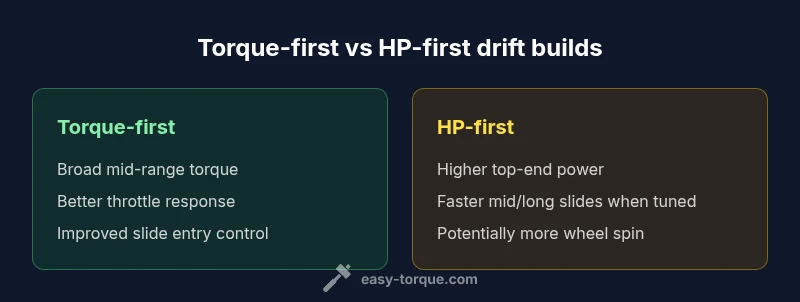
| Feature | Torque-first drift build | Horsepower-first drift build |
|---|---|---|
| Power delivery | Broad mid-range torque, smooth throttle response | Higher top-end power, benefits at high RPM |
| Drift entry feel | Predictable, quick initiation | Stronger acceleration once in drift, but slower to initiate |
| Tire wear impact | Lower risk of abrupt wheelspin at entry | Higher peak power can cause wheelspin if not tuned |
| Gear compatibility | Optimize gear ratios for torquey feel across gears | Often relies on taller gears to exploit HP |
| Tuning complexity | Moderate tuning focused on mid-range torque | Broader power tuning required to balance pace across RPM |
Pros
- Improved throttle control and slide predictability with torque-first builds
- Better consistency across entry and mid-drift sections
- More forgiving power delivery in variable track conditions
- Can be tuned to maximize mid-range torque without sacrificing top-end performance
Drawbacks
- Overemphasis on torque can lead to tire wear if not managed
- High-HP-only setups may be faster on long straights but less controllable in corners
- Torque tuning complexity increases with engine swaps and gearing changes
Torque-first drift builds generally outperform HP-first builds for most drifting scenarios.
For most drivers, prioritizing torque in the usable RPM range improves entry, grip, and consistency. Use horsepower to augment top-end pace after you achieve reliable slides.
Your Questions Answered
Is torque more important than horsepower for drifting?
In drifting, torque in the usable RPM range is usually more important than peak horsepower because it governs throttle response and grip during entry and mid-drift. horsepower still plays a role in pace after transitions, but without torque, you struggle to initiate and control slides.
For drifting, torque matters most because it controls throttle response and grip during entry and mid-drift. Horsepower helps after the drift, but torque leads the show.
Can a high-hp engine drift well without torque?
A high-HP engine can drift, but without sufficient usable torque, entry and mid-drift control can suffer. You may rely more on precise gearing and driver input to compensate for the lack of mid-range torque.
High horsepower helps pace, but without usable torque, entry control and throttle modulation suffer.
How should you tune a drift car for torque?
Focus on shaping a broad torque curve in the RPM band you use on track. This involves optimizing turbo sizing, cam timing, and exhaust flow to flatten torque, plus selecting gearing that keeps the engine in the target window.
Tune for a broad torque curve in the RPMs you actually use, and keep gearing in that band.
What role do gears play in torque vs HP for drifting?
Gearing translates engine torque into wheel torque. Shorter final drives help keep you in the torque window, aiding entry and control, while taller gears can preserve top speed but may hurt throttle immediacy.
Gears determine how quickly you access torque at the wheels; the right setup keeps you in the sweet spot.
Does NA vs turbo affect torque for drifting?
Turbo systems can broaden the usable torque band earlier, improving entry and mid-drift control, but must be tuned to avoid lag. Naturally aspirated engines rely more on gearing and cam timing to shape torque delivery.
Turbo tends to give earlier torque; NA relies more on gearing and cam timing.
Is there a single best drift setup for every car?
No universal best setup exists. The optimal balance depends on the car, track, tire compound, weight distribution, and driver style. Use torque as a guiding principle and adjust horsepower to suit the situation.
There isn’t one perfect setup; tune to your car and track, using torque as the guide.
Top Takeaways
- Prioritize mid-range torque for drift entry
- Balance torque with gearing to optimize tire grip
- Use HP to supplement, not lead, drift power
- Tune for throttle response first