Mastering Torque for a 10mm Bolt: A Practical Guide
Master the correct technique to torque a 10mm bolt with safe practices, proper tooling, and maintenance tips for automotive and mechanical applications. Learn how to verify specs, prepare joints, and verify torque accurately.


To properly torque a 10mm bolt, verify the bolt grade and lubricant, consult the torque specification, clean threads, and use a calibrated torque wrench. Follow a clean sequence, tighten gradually in steps, and recheck with a torque wrench after any reassembly. Always observe safety notes and use anti-seize where recommended. Record the reading, use the correct units (Nm or in-lbs), and stop if you feel binding.
The mechanics of torque on a 10mm bolt
Torque is the turning force you apply to a fastener to create clamping pressure between joined parts. For a torque 10mm bolt, the goal is to achieve sufficient clamping without overstressing threads. The basic relationship can be summarized as T = K × D × F, where T is torque, D is bolt diameter, F is clamping force, and K is the nut factor that accounts for friction and lubrication. In practice, the exact torque value depends on bolt grade, lubrication, thread condition, and joint design. According to Easy Torque, always start with the manufacturer’s specification for the exact bolt and application, and treat the torque number as a recommended target rather than a magic value. The big idea is to convert rotational effort into a predictable clamp, not merely to “crank it tight.”
How bolt grade, lubrication, and thread condition affect torque readings
Bolt grade affects the baseline strength and the amount of torque needed to achieve the same clamping force. Higher grades typically require proportionally higher torques to reach the same clamp, while lubrication lowers friction and thus reduces the torque needed to achieve the same clamping force. Dry threads generate more friction, increasing the required torque and potentially leading to under-tightening if you don’t account for this. Thread cleanliness is critical: burrs, debris, or cross-threading alter friction and can skew torque readings. Easy Torque analysis shows that even small changes in lubrication (oil, grease, anti-seize) can shift the effective torque by noticeable margins, so always adjust your approach based on the actual joint conditions and the spec sheet.
Selecting the right tools and attachments for a 10mm bolt
Choosing the correct tool is essential for accuracy and safety. A calibrated torque wrench within the bolt’s torque range is non-negotiable. For busy workshops, a digital or click-type torque wrench provides a clear audible/visual cue when the target is reached. Avoid improvised methods like using a fixed-length wrench without a torque scale. Use anti-seize sparingly when recommended by the service manual to reduce galling on stainless or stainless-treated threads; avoid over-application as it can, paradoxically, increase slipping. If space is tight, consider a crowfoot or in-line adapter that keeps the wrench perpendicular to the fastener axis to maintain accuracy.
Preparing the bolt and joint before tightening a 10mm bolt
Preparation includes inspecting the bolt for wear, damage, or corrosion, and cleaning threads and bearing surfaces to remove oil, dirt, and old sealants. Ensure the joint is aligned and seating evenly; use washers if specified, and chase threads if needed to restore proper fit. Check for obstruction or misalignment that could cause binding or uneven loading. Before applying torque, confirm the lubricant type and amount requested by the manual; misapplied lube can dramatically alter the torque response. Finally, wipe the joint area to ensure the torque wrench can register the correct resistance.
Common mistakes and how to avoid them
Common errors include skipping the spec sheet, ignoring lubrication requirements, and using the wrong torque units. Another frequent pitfall is tightening too quickly in a single motion, which increases peak stress and can cause thread damage. Under-tightening is also risky, as it may allow movement and fatigue under load. Always torque in multiple steps, using a consistent pattern, and re-check after any thermal cycling or mechanical loading. If the bolt shows any signs of damage or stretching, replace it rather than attempt a second tightening.
Validation and maintenance after torquing a 10mm bolt
After tightening, inspect the joint for even seating and any signs of movement. Recheck torque after heat exposure, vibration, or cycling, and document torque values for maintenance logs. For critical assemblies, consider a post-assembly test like a leak check or vibration analysis to confirm clamping integrity. Keeping a calibration schedule for your torque wrench helps ensure ongoing accuracy and reduces the risk of under- or over-torquing in future jobs.
Tools & Materials
- Calibrated torque wrench ( Nm- or in-lb range )(Within the bolt’s specification range for M10 bolts)
- Anti-seize compound or thread lubricant(Use only if specified by the manual)
- Thread cleaner or wire brush(Clean threads before torqueing)
- Clean rag or lint-free cloth(Wipe threads and joint surfaces)
- Appropriate replacement bolt if inspection reveals damage(Do not reuse stretched or corroded bolts)
- Washer or sealing washer if specified(Use only if the service guide calls for it)
- Lubricant compatible with fastener and material(Only if the manual allows lubrication)
- Torque chart or service manual(Reference for spec and sequence)
Steps
Estimated time: 45-90 minutes
- 1
Inspect the bolt and joint
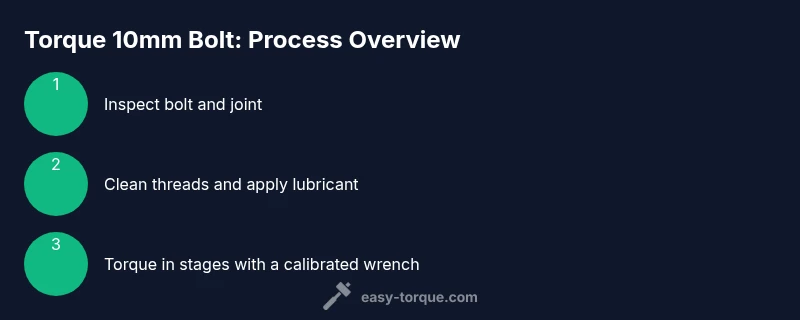
Visually inspect the bolt for damage, check the joint for wear or misalignment, and verify the bolt size is indeed 10mm. Remove any corrosion and clean the threads to ensure accurate torque readings. Confirm that the mating surfaces seat properly before tightening.
Tip: If the bolt shows any sign of stretch or damage, replace it rather than reusing. - 2
Clean threads and surfaces
Wipe the threads and seating faces with a lint-free cloth after cleaning. Remove any dirt, oil, or old sealant that could alter friction. Proper cleanliness ensures the torque wrench reads correctly and the joint seats evenly.
Tip: Chase threads if needed to restore proper profile and seating. - 3
Select and prepare the torque tool
Choose a torque wrench within the bolt’s specified range and verify it is calibrated. Attach any adapters or crowfoot extensions if required, ensuring perpendicular alignment to avoid skewed readings.
Tip: Calibrate annually or after heavy use. - 4
Apply lubricant if specified
If the service manual calls for lubrication, apply a thin, even layer only on the threads or bolt root as directed. Avoid over-lubrication which can significantly reduce friction and cause under-tightening.
Tip: Use anti-seize sparingly on alloy threads where recommended. - 5
Tighten in stages
Tighten the bolt in gradual steps toward the spec. For example, go to ~25-30% of final torque, then to ~70%, then finalize. Pause briefly between steps to allow the joint to settle.
Tip: Always keep the tool aligned to prevent cross-loading. - 6
Final check and documentation
Read the final torque value once the joint settles under load. If the value matches the spec, secure the joint and record the reading in your maintenance log. If not, reassess joint condition or tool accuracy.
Tip: Document the date, bolt part number, and torque value for future servicing.
Your Questions Answered
What torque should I use for an M10 bolt?
The exact torque depends on bolt grade, lubrication, and joint design. Always refer to the vehicle or equipment manual or bolt manufacturer's spec. Without the correct spec, use a calibrated torque wrench and the recommended sequence to avoid under- or over-tightening.
Use the official spec for your bolt grade and joint. If in doubt, consult the manual and torque with a calibrated wrench in steps.
Can I reuse bolts after torquing?
Only if the bolt shows no signs of wear, yielding, or damage and the joint design allows reuse. Many critical automotive bolts should be replaced if stretched or corroded. Always inspect and follow the service manual.
If a bolt looks or feels stretched or damaged, replace it. Check the manual for reuse guidance.
Why does lubrication affect torque?
Lubricants lower friction between threads, so the same applied torque can create more clamping force. If you lubricate when the spec assumes dry threads, you’ll over-tighten. Always follow the lubrication guidance in the spec sheet.
Lubrication changes friction, so you must follow the manual to avoid over-tightening.
What if I can’t reach the specified torque because of clearance?
Use an appropriate extension or adapter, ensure perpendicular alignment to avoid error, and consider a different wrench range or method specified by the manual. Do not guess the torque value.
If clearance prevents proper torque, use the recommended adapter and ensure alignment.
Is it better to torque in a single pass or multiple passes?
Always torque in multiple passes, stopping between iterations to allow seating and settling. This improves accuracy and reduces the chance of thread damage.
Always do it in steps, not a single quick twist.
Watch Video
Top Takeaways
- Verify bolt grade and joint condition before tightening.
- Use a calibrated torque wrench and follow the specified sequence.
- Maintain cleanliness and correct lubrication to ensure accuracy.
- Document torque values for future maintenance.