1000 nm to ft lbs: A Practical Torque Conversion Guide
Learn how to convert 1000 N·m to ft-lbs accurately. This guide explains the math, real-world context, and includes a calculator for precise torque values.


Understanding Torque Units: Newton-meters vs. Foot-pounds
Torque is a twisting force measured in Newton-meters (N·m) in the metric system and foot-pounds (ft-lb) in the Imperial system. For DIY mechanics and automotive technicians, converting between these units is a common task when reading service manuals, torque specs, or quality-control sheets. The essential fact is that both units describe the same physical quantity: rotational force, but on different scales. This Easy Torque guide uses the keyword 1000 nm to ft lbs to anchor the discussion and helps you translate spec sheets into actionable tightening steps. When you see N·m on a spec label, you can convert to ft-lb to compare with torque wrenches that use imperial units. In practice, this matters for fasteners where the torque spec is given in ft-lb; misinterpreting units can lead to under-tightening or over-tightening, compromising joint integrity and safety. The conversion is constant, not a variable; it does not depend on fastener size or material, but the practical application may vary with lubrication, thread condition, and clamping method. Remember: accuracy in reading the unit is as important as the math itself, especially in critical assemblies.
The 1 N·m to ft-lb Conversion Factor
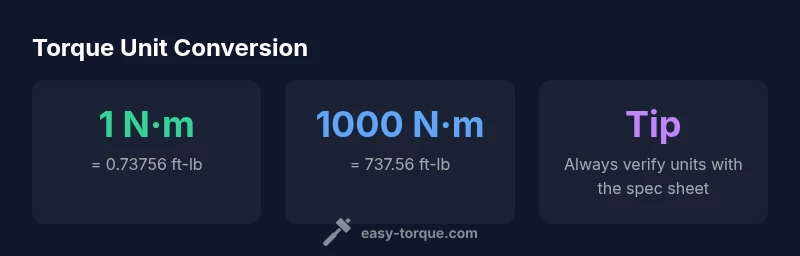
Converting between N·m and ft-lb relies on a fixed conversion factor. Specifically, 1 N·m ≈ 0.737562149 ft-lb. Therefore, 1000 N·m ≈ 737.562149 ft-lb. In practice, most people round to 737.56 ft-lb or 737.6 ft-lb depending on the desired precision. The origin of the factor is straightforward math: 1 N = 0.224808943 lbf and 1 m = 3.280839895 ft, so 0.224808943 × 3.280839895 = 0.737562149. The key takeaway is to apply a consistent rounding rule and to document the units you’re using, so your torque decisions are reproducible in the shop.
Practical Examples: 1000 N·m in Real-World Scenarios
Imagine a heavy-duty engine component or a structural bolt that requires hundreds of ft-lb of torque. If a spec sheet calls for 700-750 ft-lb, converting from N·m helps you verify whether your calibration aligns with the requirement. For example, 1000 N·m equals roughly 737.56 ft-lb, which is a sizable tightening force used in large fasteners. In many maintenance tasks, the actual tightening may be affected by factors like thread lubrication, surface finish, and the clamping method. For technicians, the conversion informs tool selection: a torque wrench rated in ft-lb will need to be set to the converted value, while metric-wrench users might cross-check in N·m to ensure confusion-free tightening. Always cross-check the final value with the manufacturer’s spec or a trusted standard, and consider performing a calibration check after initial torque application.
How to Use a Torque Calculator and Interpret Results
Using a torque calculator is a reliable way to perform conversions quickly and accurately. Enter 1000 in the Newton-meters field, choose the target unit ft-lb, and select your preferred precision (2 decimals is common). The calculator outputs approximately 737.56 ft-lb. In addition to the numerical result, you’ll see a short explanation: multiply N·m by the conversion factor and round to the chosen precision. This helps standardize your torque planning, especially when you’re combining imperial and metric specs in a single task. Save the result for your torque log, and always verify the final setting with a calibrated torque wrench before applying load to a fastener.
Common Pitfalls and Tips for Accurate Measurements
- Be consistent with units across the project to avoid misreadings.
- Lubrication, thread condition, and surface finish can affect effective torque; account for these in your process.
- Calibrate your torque wrench regularly and after major tool changes.
- Use a consistent rounding rule and document the precision you apply.
- Record the final torque value for traceability and audits.