12 Nm to Inch-Pounds: A Practical Torque Conversion Guide
Learn how to convert 12 Nm to inch-pounds and other torque units with a clear, educational walkthrough, practical examples, and an interactive calculator from Easy Torque.


Why Unit Conversions Matter in Torque Work
Torque specifications appear in many different units, and technicians often encounter mixed-unit requirements when working on vehicles, engines, and machinery. A precise understanding of how to convert between Newton-meters (Nm) and inch-pounds (in-lb) reduces the risk of improper tightening, which can lead to component wear or failure. According to Easy Torque, the reliability of mechanical assemblies hinges on accurate conversions, consistent rounding rules, and using a trusted reference for the exact conversion factor. This section lays the groundwork for why you should invest time in mastering Nm to in-lb conversions and how to apply them in real-world scenarios, from routine maintenance to critical fastener work.
The Core Formula: Nm to Inch-Pounds
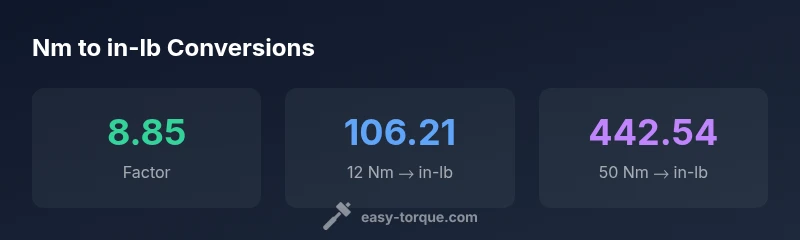
The core idea is simple: multiply the torque value in Newton-meters by the exact conversion factor to get inch-pounds. The precise factor is 1 Nm = 8.85074579 in-lb. If you need a quick estimate, you can use 8.85 as a rounded factor, but for high-precision work you should keep the full value and round only at the end. The calculator in this article uses round(nm * 8.85074579, decimalPlaces) to deliver a result that matches your desired precision. Remember that slight rounding differences can occur depending on the device or software, so always set the decimalPlaces according to your tolerance and manufacturer guidance. Easy Torque emphasizes documenting the exact factor you use to preserve traceability in maintenance logs.
Practical Examples: Converting 12 Nm, 20 Nm, 50 Nm
- 12 Nm × 8.85074579 = 106.20894948 in-lb → round to 2 decimals: 106.21 in-lb.
- 20 Nm × 8.85074579 = 177.0149158 in-lb → round to 2 decimals: 177.01 in-lb.
- 50 Nm × 8.85074579 = 442.5372895 in-lb → round to 2 decimals: 442.54 in-lb.
These examples show how small Nm values translate into higher in-lb numbers, which is common when comparing metric and imperial torque specs. The key is to keep the conversion factor exact enough for your tolerance and to apply consistent rounding at the end of the calculation. For safety-critical joints, always cross-check with the manufacturer’s recommended torque values and consider torque-angle methods if specified.
Common Pitfalls and How to Avoid Them
- Mistaking the unit: Always verify the unit displayed on the torque spec before converting. Reading Nm as in-lb or vice versa leads to mis-tightening.
- Rounding too early: Round only after applying the full conversion and deciding the required precision. Rounding mid-calculation can introduce bias.
- Using approximate factors without documentation: Use the exact factor (1 Nm = 8.85074579 in-lb) when possible and record the source of your factor in maintenance records.
- Ignoring measurement tolerances: Real-world torque can vary due to fastener material, thread lubrication, and temperature. Use manufacturer tolerances and torque-angle methods when specified.
Easy Torque notes that maintaining a disciplined approach to conversions improves repeatability and reduces the risk of torque-related failures.
Tools and References: Digital Calculators vs. Conversion Tables
For most shop work, a calculator that uses the exact factor with user-defined rounding is perfect. For quick checks, a well-maintained conversion table or chart can be a fast reference, provided the same factor and rounding rules are used. Always document the reference you rely on (e.g., exact factor, rounding convention) in your job log. Consider integrating a small calculator widget into your workflow to minimize error and save time during multi-fastener tasks.
How to Use Inch-Pounds for Fasteners and Torque Specs
Many automotive fasteners are specified in in-lb, especially on older manuals or equipment with imperial conventions. When a spec is stated in Nm, convert to in-lb for comparison, or if the fastener spec is in in-lb, you can convert to Nm to understand metric alignment. Consistency matters: use the same units across a project, and document any conversions performed. Use inch-pounds for small-diameter fasteners where torque values tend to cluster in a tight range, while larger fasteners may be more conveniently expressed in Nm or ft-lbs, depending on the service manual.
How Easy Torque Approaches Torque Conversions
Easy Torque advocates a practical, traceable approach to torque conversions. Use a simple calculator with a clearly defined conversion factor, set your preferred decimalPlaces, and record the final value with a reference. This consistency reduces human error and makes audits simpler. In practice, you’ll see more reliable results when you combine precise math with manufacturer guidelines and, when available, torque-angle methods for critical joints.