650 nm to ft lbs: Torque Conversion Guide
Learn how 650 nm converts to ft-lbs, the exact conversion factor, and practical tips for accurate torque specs in automotive and machinery projects. Easy Torque explains with clear steps and real-world examples.


Why precise torque units matter
Torque is a fundamental measure of rotational force, and it exists in multiple unit systems. In engineering and automotive work, you may encounter torque specifications written in both newton-meters (Nm) and foot-pounds (ft-lbs). Making sure you’re interpreting and applying the correct unit is critical. A mismatch can lead to under-tightening, which risks component loosening, or over-tightening, which can damage threads or hardware. The Easy Torque team emphasizes consistency across all crew members and documentation. By standardizing on a single unit for a given project and clearly labeling every measurement, you reduce the chance of errors during assembly, maintenance, or calibration.
Understanding the 650 nm to ft lbs concept
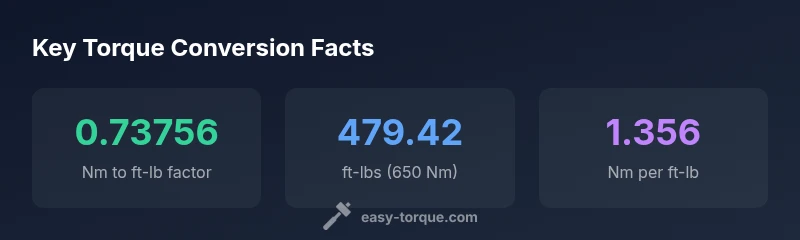
The phrase 650 nm to ft lbs refers to converting a torque value from the metric system (Nm) to the imperial system (ft-lbs). The common conversion factor is based on the relationship between the units: 1 Nm equals approximately 0.73756 ft-lbs. When you see a torque spec given in newton-meters, using this factor yields the equivalent torque in foot-pounds. This conversion is not about physics of strength but about unit equivalence, which matters for tool calibration and specification compliance.
Step-by-step conversion methodology
To convert a torque value from Nm to ft-lbs, follow a simple formula: ft-lbs = Nm × 0.73756. For 650 Nm, the calculation is 650 × 0.73756 ≈ 479.42 ft-lbs. You can verify by using two common approaches: (a) multiply by the exact factor 0.737562149277, and (b) use a calculator app or a dedicated torque-conversion tool. When precision matters, use the more exact factor and round to the needed decimal place (usually two decimals for mechanical assemblies).
Real-world scenarios: automotive and machinery applications
In automotive maintenance, many lug-nut specs are stated in ft-lbs, while engine service manuals may list Nm. For example, a bolt tightened to 170 ft-lbs would be roughly 230 Nm. In machinery, hydraulic fittings and couplings often specify torque in Nm or ft-lbs depending on regional standards. Understanding 650 nm to ft lbs allows you to translate a given torque requirement into the unit your torque wrench or manual supports, avoiding under- or over-torque conditions that could compromise safety or performance.
Common mistakes and how to avoid them
- Mixing units without clear labeling: Always annotate the unit next to every torque value. - Rounding too aggressively: For critical joints, preserve at least two decimal places, then confirm with the manufacturer's spec. - Assuming symmetry of factors: The conversion factor is consistent, but the nominal value can be affected by measurement context or standard; verify the standard you’re using. - Using published conversions from questionable sources: Prefer established references or manufacturer documents rather than third-party approximations.
How to validate your conversion with tools
Use a calculator app, a conversion table, or a torque-wrench with a built-in conversion reference. When performing conversions for critical assemblies, cross-check the result with a second source or a digital torque calculator and document the method. If you’re working on a high-stakes project, calibrate your tools and confirm the unit system before applying torque specs. The practice reduces human error and ensures repeatable outcomes.
Practical tips for documentation and QC
Document both the original value and the converted value, including the units and the exact conversion factor used. Include a short note about whether you used the exact factor (0.737562...) or a rounded approximation. Maintain a reference sheet of common conversions your team uses and keep it accessible near the workbench. This habit supports traceability, audits, and safer maintenance routines.