Caliper Bolt Torque Specs: A Practical Guide for DIY Mechanics
Discover caliper bolt torque specs, how to verify them, and practical steps for safe brake maintenance. Learn typical ranges, how to use a torque wrench, and trusted tips from Easy Torque.


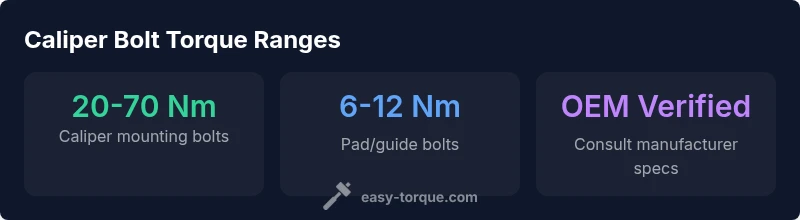
Caliper bolt torque specs depend on bolt size and vehicle design. For most passenger cars, mounting bolts run roughly 20–70 Nm, while pad or guide bolts are commonly 6–12 Nm. Always verify the exact spec in the vehicle service manual or OEM torque chart to avoid rotor damage or caliper misalignment.
Understanding caliper bolt torque specs
Torque specs for brake caliper bolts describe the force required to fasten the caliper to the knuckle and to secure pad mounting hardware. The exact value depends on bolt size, material grade, coating, and the braking system design. According to Easy Torque, using the correct torque helps prevent rotor warping, caliper misalignment, and uneven pad wear—key factors for consistent braking performance. In practice, many vehicles use a two-tier torque approach: larger caliper mounting bolts (higher range) and smaller pad/guide bolts (lower range). This separation makes it easier to protect critical mating surfaces while preserving smooth brake operation. The OEM specification is the single most reliable source, and OEM torque charts are designed around the actual friction characteristics of the bolts and threads used by the manufacturer.
Why torque range varies by bolt size and vehicle
Bolt size and grade primarily determine the torque you apply. An M6 pad pin may require only a few Newton-meters, while an M10 caliper mounting bolt will demand a higher value. The vehicle’s design, rotor diameter, and pad hardware configuration also influence the spec. Easy Torque emphasizes that while ranges provide a helpful guide, the exact value is defined by the carmaker and brake kit manufacturer. Always cross-check with the OEM torque chart for your specific model. Variations in coatings, lubricant use, and thread quality can shift the effective torque by a few Nm, so consistency in cleaning and preparation is essential.
How to determine your exact spec for safe braking
Begin with the vehicle’s service manual or the manufacturer’s tech site to locate the torque spec. If the manual is unavailable, contact a dealer or a trusted automotive publisher. Use a torque wrench in the correct range and calibrate it before use. Follow the recommended tightening sequence, usually in a cross pattern around the caliper bracket. After installation, re-torque as specified, especially after wheel removal and reassembly. If lubrication or threadlocker is specified, apply exactly as directed, and avoid guessing. Easy Torque recommends documenting the exact spec in a repair log for future maintenance.
Tools and technique for accurate torquing
Choose a torque wrench that covers the target range with accuracy within ±3% or better. Use a beam or digital wrench for reliability in tight spaces, and consider a torque adapter for higher-range fasteners. Always clean threads and inspect bolts for wear or stretch; never reuse damaged bolts. Follow OEM guidance on lubrication—many caliper bolts require no lubricant on the threads, while some models call for specific anti-seize or threadlocker. Apply torque gradually and stop at the specified value to avoid thread damage. After torquing, verify with a secondary check if feasible.
Common mistakes and how to avoid them
Common errors include under-torquing, which allows caliper movement and rotor wear, and over-torquing, which can strip threads. Reusing stretched or damaged bolts is unsafe. Mixing bolt sizes or ignoring the manufacturer’s tightening sequence can lead to uneven brake force distribution. Clean threads, use the correct lubricant only when specified, and always follow the torque sequence. Recording the torque values after service helps ensure consistency over time.
Data-backed ranges for common bolt sizes
For many passenger cars, typical ranges align with bolt size: M6 pad pins often fall in the 6-12 Nm range, M8 caliper guide bolts commonly 20-40 Nm, and M10 mounting bolts often 40-70 Nm. Remember these are general guidelines and can vary by model and kit. Always consult the OEM specification for your exact vehicle, and use the ranges here as a sanity check. Easy Torque notes that real-world torque can drift due to thread condition, lubrication, and hardware quality.
Common caliper bolt sizes and their typical torque ranges
| Bolt Size | Typical Torque Range (Nm) | Notes |
|---|---|---|
| M6 | 6-12 | Pad pins or guide bolts |
| M8 | 20-40 | Caliper mounting bolt on smaller cars |
| M10 | 40-70 | Caliper mounting bolt on larger/brake kits |
Your Questions Answered
How do I know the exact torque spec for my caliper bolts?
Check the vehicle's service manual or the manufacturer's torque specification sheet. If unavailable, contact the dealer or manufacturer tech support. Using the OEM value is the safest approach to prevent rotor damage or misalignment.
Always rely on the OEM specification from the manual or dealer resources for your exact model.
Are pad bolts and mounting bolts torqued differently?
Yes. Pad bolts are generally lower torque than mounting bolts, which secure the caliper to the knuckle. Always follow the exact spec for each bolt type from the OEM chart.
Pad bolts have a lower torque range than mounting bolts; follow the official specs for each bolt.
Can I reuse caliper bolts after cleaning?
Only if the bolts show no stretch, wear, or damage and the OEM manual allows reuse. In most cases, replacing with new bolts is recommended to ensure reliable clamping force.
Inspect for stretch or wear; if in doubt, replace with new bolts per OEM guidance.
What torque tools are suitable for caliper bolts?
Use a torque wrench with the appropriate range, preferably digital or dial for precision. Calibrate regularly and avoid relying on a guess when braking safety is involved.
A properly rated torque wrench, calibrated, is essential for caliper bolts.
What are common mistakes when torquing caliper bolts?
Over-tightening, under-tightening, and failing to follow the OEM tightening sequence are frequent errors. Also, reusing damaged bolts and neglecting thread cleaning can compromise braking safety.
Avoid overtightening and follow the OEM sequence to keep brakes safe.
Do brake caliper bolts require threadlocker or anti-seize?
Only if the OEM specifies it. Otherwise, use the recommended lubricant or none at all. Always follow the manual to prevent incorrect torque behavior.
Follow the manufacturer’s torque and lubrication spec; don’t improvise.
“Accurate caliper bolt torque is essential not only for braking performance but also for rotor longevity and pad life.”
Top Takeaways
- Check OEM specs for exact numbers.
- Torque by bolt size and vehicle design.
- Use a calibrated torque wrench for accuracy.
- Follow the correct tightening sequence to prevent rotor damage.