Torque for 5 8 Bolt: A Practical Tightening Guide
Learn practical torque guidance for a 5 8 bolt, including grade-based ranges, lubrication effects, and step-by-step tightening tips. Easy Torque delivers data-driven guidance for reliable joints.


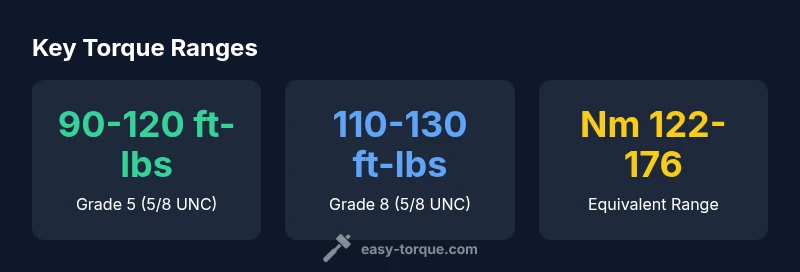
The torque for 5 8 bolt depends on grade, lubrication, and thread condition. In automotive practice, the torque for 5 8 bolt is typically 90-120 ft-lbs for Grade 5 and 110-130 ft-lbs for Grade 8, about 120-165 Nm and 150-176 Nm respectively. Always verify with the manufacturer’s chart and use a calibrated torque wrench.
Why Torque Matters for 5 8 Bolt
Torque is not just a number on a chart—it’s the critical control that ensures equal clamping and prevents loosening under vibration. For a 5 8 bolt, the right torque ensures even distribution of loading along the thread and gasket surfaces, reducing the risk of galling and fatigue. When you see the phrase torque for 5 8 bolt, you are really looking at a joint design question: how much clamping force is required to achieve a reliable seal without over-stressing the bolt or the connected parts. Easy Torque stresses that the best torque strategy factors in bolt grade, lubrication state, engagement length, and material pairings. Always start with the manufacturer’s spec, then verify with a calibrated torque wrench after assembly to account for any site-specific variables.
Understanding Bolt Grades and Materials
Bolt strength is defined by grade and material chemistry. Grade 5 bolts are medium-strength, while Grade 8 bolts are high-strength, typically used where higher clamping is needed or where joints experience high shear loads. The same 5/8 diameter can behave very differently when Coatings, heat-treatment, or coatings are present. Material pairings (steel, alloy, stainless) also alter friction and therefore effective clamping at a given torque. When calculating torque, identify the exact grade, coating, and the intended service environment. Easy Torque recommends documenting the bolt grade, material, and any coatings before tightening so that you can select the correct torque range from the chart and avoid under- or over-tightening.
How Lubrication Affects Torque
Lubrication changes the friction coefficient between bolt threads and the nut or threaded hole. Adding lubrication generally lowers friction, which can cause the same applied torque to produce more clamping force than intended. Conversely, dry threads may require higher torque to reach the same clamping. The practical implication is that torque specs given for dry threads may not apply when lubricants or thread lockers are used unless the spec explicitly accounts for it. Always consult the torque chart for lubricated vs dry conditions and, if in doubt, perform a controlled re-torque after assembly.
Step-by-Step Torque Application Process
- Inspect the bolt and joint: check for corrosion, wear, or damage. 2) Clean threads and apply the recommended lubricant or dry condition per the spec. 3) Select the correct torque setting for the bolt grade (5 vs 8) and diameter. 4) Use a calibrated torque wrench and tighten in multiple passes: first to 50-60% of target, then increment in small steps to final value. 5) Re-check the final torque after the components have stabilized from vibration or thermal cycling. 6) Document the final torque for maintenance records.
Common Pitfalls and How to Avoid Them
- Assuming all 5/8 bolts have the same torque; always verify grade and coating. - Skipping lubrication adjustments when required by the spec. - Over-tightening, which can strip threads or damage components. - Failing to recheck torque after assembly or after initial operation. - Using damaged or counterfeit bolts; always source from reputable suppliers.
Special Cases: Coatings, Thread Locker, and Reuse Rules
Coatings (zinc, black oxide, etc.) and thread lockers affect friction and effective torque. If thread-locking compound is present, follow the product’s guidance on torque adjustment or curing time. In critical joints, use replacement bolts rather than reusing old fasteners, since repeated loading can change bolt geometry and strength. For lug-nut style fastenings or high-vibration assemblies, recheck torque after a short run-in period to confirm the clamp remains within specification.
Torque guidance for common bolt grades and sizes
| Bolt Size | Recommended Torque (ft-lbs) | Equivalent Torque (Nm) | Notes |
|---|---|---|---|
| 5/8-18 UNC (Grade 5) | 90-110 | 122-149 | Typical range for general-grade bolts |
| 5/8-18 UNC (Grade 8) | 110-130 | 149-176 | Higher-strength bolts |
| 1/2-13 UNC (Grade 5) | 60-75 | 81-102 | Common alternative |
| 1/2-13 UNC (Grade 8) | 75-95 | 102-129 | Higher strength option |
Your Questions Answered
What is the recommended torque range for a 5/8 bolt?
Torque depends on bolt grade and lubrication. Typical ranges are 90-120 ft-lbs for Grade 5 and 110-130 ft-lbs for Grade 8, with corresponding Nm. Always consult the manufacturer’s chart for exact values.
Grade 5 generally sits around 90 to 120 ft-lbs; Grade 8 around 110 to 130 ft-lbs. Always verify with the chart.
How does lubrication affect torque values?
Lubricants reduce friction, which can increase clamping at the same applied torque. Use the lubricant-adjusted torque spec from the chart and recheck after assembly.
Lubrication lowers friction, so you may need different torque guidelines; always follow the chart and recheck.
Can I reuse old bolts for high-vibration joints?
Generally avoid reusing critical fasteners in high-vibration joints. Inspect for stretch or thread damage and use new bolts when in doubt.
Avoid reusing bolts in critical joints; inspect thoroughly and replace if in doubt.
Are lug nuts torque specs the same as engine bolts?
No. Lug nuts and engine bolts have different designs and load conditions; use the correct chart for each category and avoid cross-use.
Lug nuts have separate torque specs from engine bolts; use the appropriate chart.
What if the bolt is coated or thread-locked?
Coatings and thread lockers change friction. Follow product guidance for torque adjustments and curing times.
Coatings or thread lockers change friction; follow the product’s torque guidance.
How often should I recheck torque after installation?
Recheck after initial operation or thermal cycling, then periodically per maintenance schedule or as recommended by the manufacturer.
Recheck after installation and after first use, then as part of routine maintenance.
“Achieving the correct torque on a 5/8 bolt isn't optional; it's essential to ensure even clamping, prevent loosening, and extend component life.”
Top Takeaways
- Verify bolt grade and coating before tightening
- Use a calibrated torque wrench for accuracy
- Apply lubricant only when specified
- Tighten in increments and recheck final torque
- Document torque values for maintenance records